
version française
The FLAG Art Foundation was created in 2008 by Glenn Fuhrman, former managing director at Goldman Sachs, Managing Partner at MSD Capital and now Co-founder of Tru Arrow Partners. In addition to his successful career in finance, Glenn Fuhrman possesses a profound understanding of art, thanks to his strong educational background including degrees in art history from the Wharton School and University College of London, as well as being the student of Leo Steinberg at Penn University.
Much like Charles Saatchi, whose groundbreaking exhibitions in London ignited new artistic movements, Fuhrman’s vision for The FLAG Art Foundation is rooted in a desire to present thought-provoking exhibitions to inspire dialogue.
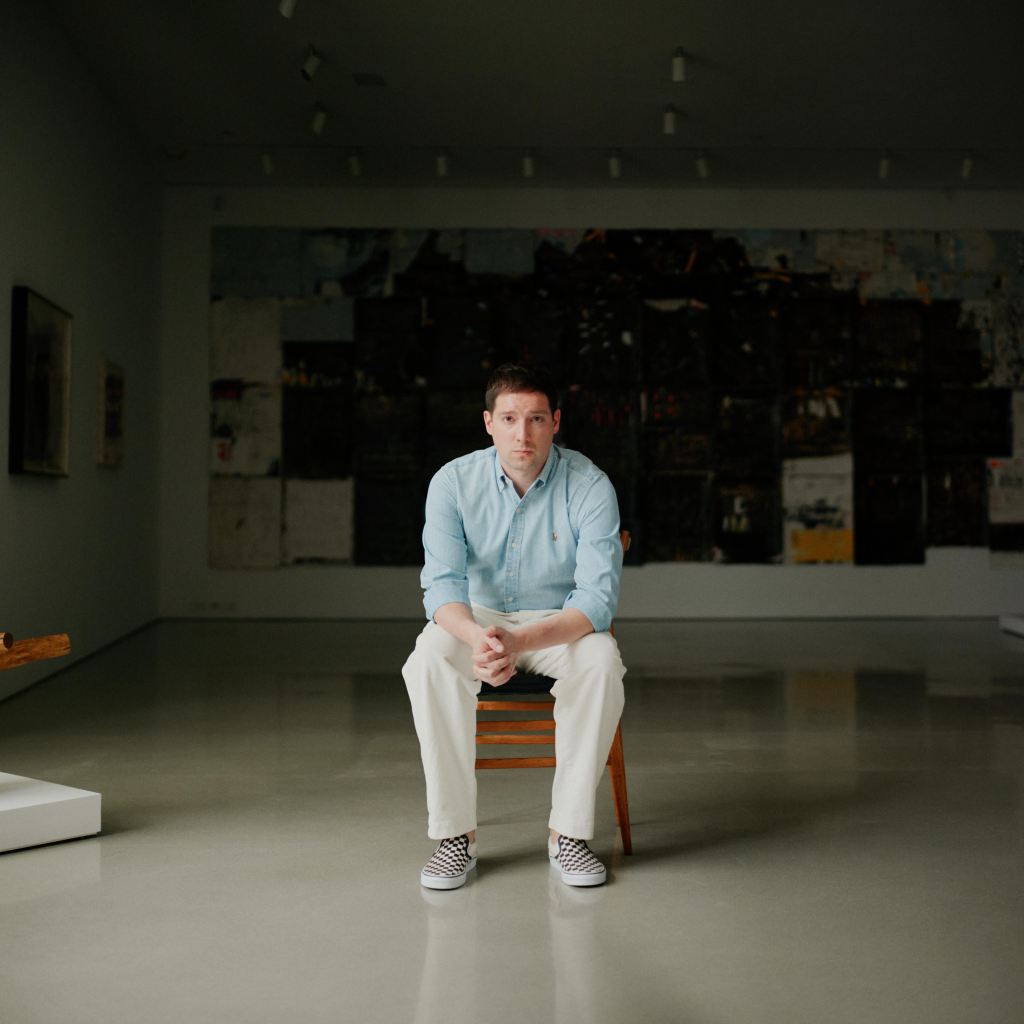
The foundation is currently directed by Jonathan Rider who joined FLAG in 2014 as associate director and curator, working alongside former director Stephanie Roach. During that time they organized noteworthy exhibitions such as Shaq Loves People, Etel Adnan | Gerhard Richter, Ashley Bickerton, Elmgreen & Dragset: Changing Subjects, and many more.
Along with his team, Jon implements a dynamic and thoughtful program, featuring a mix of group exhibitions and solo exhibitions by both internationally acclaimed and emerging artists. To do so, the foundation collaborates with museums, galleries, collections, and artists themselves to secure loans of artworks for each exhibition.
- The FLAG Art Foundation is a private institution, but its main purpose is not to exhibit the collection of its founder, Glenn Fuhrman. Therefore, what is the mission of the foundation?
{JR} : FLAG’s mission is to encourage the appreciation of contemporary art among diverse audiences through rotating exhibitions, which are always free and open to the public. The first five years were marked by thematic group shows curated by a broad range of creative individuals – including writers, curators, artists, and sport figures, as well as internally curated exhibitions centering on timely issues.
Operating in the spirit of a kunsthalle, FLAG actively borrows artworks from a variety of sources for our exhibitions with many of the artists creating new works for the shows. The ideas in each project are then expanded through public talks and events.
In 2019, New York-based, Swiss artist Nicolas Party offered a remarkable exploration of pastels as both an artist and curator, showcasing his own work alongside pastels spanning three centuries.
Major museums have stringent regulations prohibiting the borrowing of pastel artworks due to their delicate nature, making transportation risky. As a result, Nicolas took it upon himself to acquire Carriera and Jean-Baptiste Perronneau’s works at auction, while Jon Rider facilitated the temporary loan of pastel pieces by Mary Cassatt (1844-1926) and Edgar Degas (1834-1917) from various galleries and private collections. The exhibition was characterized by wall hues that immerse each room in a different atmosphere, and Nicolas created impressive site-specific wall murals for the show.
- It seems that you are not afraid of making strong curatorial statements: take the Nicolas Party exhibition for instance… Is it important for you to get involved in that type of ambitious project?
{JR} : FLAG occupies a unique position to help artists realize ambitious exhibitions, and Nicolas Party’s Pastel was one of those dream projects. Nicolas’s vision was to create a wholistic exhibition that extended beyond the artworks to the environment in which they’re presented. After a year of studio visits and planning, he then installed the exhibition over a two-month period—a significant amount of time that FLAG has the flexibility to afford. During the first month, the space was transformed into a series of intimate, technicolor galleries (which required 30 gallons of paint) separated by arched doorways. It required another full month for Nicolas to create a series of site-specific herculean pastel wall murals inspired by François Boucher and Jean-Honoré Fragonard.
Nicolas and I love collapsing time periods and styles, and once he set a vision for the show, FLAG was able to source works to be in conversation with, and sometimes layered atop of his murals, including historic pastels by Mary Cassatt, Edgar Degas, and Marsden Hartley, which were then presented alongside contemporary artists Louis Fratino, Loie Hollowell, Loie Hollowell, Julian Martin, Toyin Ojih Odutola, Chris Ofili, Billy Sullivan, and Robin F. Williams. Nicolas helped secure a magnificent work by Rosalba Carriera, an eighteenth-century Venetian artist credited with sparking the short-lived but dazzling Rococo pastel craze. The subsequent catalog took more than a year to produce and includes interviews and an essay by feminist scholar Melissa Hyde. This exhibition and publication still represent, for me, the best of what FLAG can do to support an artist.
Not every artist or exhibition necessitates that level of buildout or support – each is their own universe – but FLAG’s adaptability allows us to change the way we work to best support artists. It’s important for us to do so, and we are game when the opportunity presents itself.
- The exhibition program shows great diversity. What criteria do you base yourself on when selecting an exhibition project?
{JR} : FLAG aims to be timely and thoughtful in its programming by presenting the most important contemporary artwork being made today. As a nonprofit exhibition space, we are interested in supporting a range of artists and ideas, which can take shape as an emerging artist’s first institutional show or working with an established artist on debuting a body of work that represents a shift in their practice. FLAG has also presented many artists first New York (and often U.S.) institutional solo exhibition, some self-curated by the artists including Ashley Bickerton (2017), Genevieve Gaignard (2018), Cinga Samson (2021), Somaya Critchlow (2023), and more. This spring, FLAG will present Kampala-based artists Ian Mwesiga’s first New York institutional solo exhibition.
The group shows are really my heart though: I like that the artworks and objects assembled here, which never came into the world with the expectation of being shown together, and which will never be shown together again, can create a conversation, a certain kind of rhythm, and maybe even magic over the course of an exhibition’s run. I am a bit of a romantic in that sense.
I am also focused on bringing a deeper academic context and a broader range of voices to create dialogue around our artists and shows. For more than a year, FLAG has commissioned essays for our Spotlight exhibition series, which centers on the presentation of a new/never-before-exhibited artwork and rotates about every four weeks. Thus far, we have commissioned academics, poets, scholars, and sometimes even the artist’s friends to create a personalized narrative around this one new artwork. Considering how fast the artworld can feel like it’s moving, the Spotlight series and corresponding essays are a means of slowing things down by focusing on one artwork at a time.
- The foundation communicates a lot on what’s going on in the contemporary art world, promoting projects from galleries and institutions that seem relevant to you. Does it say something about the way you try to interact with other members of the art community?
{JR} : FLAG is situated in the middle of one of the largest commercial gallery districts in the world and based in a city of world-class museums and nonprofit spaces, so we have access to seeing what’s happening in real time. It’s important for us to experience as much as possible, regularly and consistently, to see who and what our peers are showing (or not) and understand how we can be a thoughtful and additive member of this community.
Further, FLAG shares through its social media platforms the artists, artworks, and exhibitions that are top of our mind. I look at our Instagram, whose following is a healthy 132K followers, as our curatorial notebook. Many of the artists we highlight there either have or will likely filter into our exhibition program.
- Since you worked at the foundation, have you noticed any evolution in the way you are curating exhibitions?
{JR} : I continue to build on our mission by giving artists and guest curators a fully supportive platform to create the most dynamic exhibitions, each of which necessitates a different approach. For solo shows, we function as an editor, shaper, and producer; we work incredibly close with each of our artists in a sustained and generative ways. While there are always real-world logistics and budgets to consider, I want us to operate from a place of yes, and only say no when we absolutely need to, or when something doesn’t benefit or serve an exhibition.
I also focus on bringing an academic context and broader range of voices to create dialogue around the exhibitions. I come to contemporary art through an English Literature degree and having studied Egyptology; I am a firm believer the past informs the present, and I enjoy assembling artworks and objects from different timeframes—sometimes thousands of years apart—to be in dialogue with contemporary art. This has included a collection of ancient Egyptian scarabs featured in In Search of the Miraculous (Oct. 16–Jan. 22, 2022), and an Imperial Roman bronze statue of a dwarf pugilist featured FLAG’s recent summer show Strike Fast, Dance Lightly: Artists on Boxing.
In May 2018, The Contemporary Austin announced that the FLAG Art Foundation would team up with Suzanne Deal Booth to support the Prize that Suzanne created two years before. The new version of the prize offers a $200,000 reward, along with a solo exhibition in Austin and at The FLAG Art Foundation as well as a dedicated catalog.
- Being involved in The Suzanne Deal Booth / FLAG Art Foundation Prize is now another important part of the foundation program. How is it going so far ?
{JR} : Glenn Fuhrman was interested in initiating a major award that would be life-changing for artists, and when the opportunity arose for FLAG to collaborate with philanthropist Suzanne Deal Booth and The Contemporary Austin on an existing art prize, we jumped at the opportunity.
For each iteration of this biannual award, FLAG and TCA convene a panel of esteemed curators and professionals to nominate artists for whom they feel this opportunity would be a transformation. In 2020, the prize was awarded to Nicole Eisenman, whose practice at that point was moving toward sculpture, and in 2022, it went to Tarek Atoui, a sound-based artist working in Paris. Along with colleagues from TCA, I am meeting with Lubaina Himid–the winner of the 2024 prize–next week at her studio in the north of England to discuss her upcoming show.
Thus far, it’s been an amazing and generative opportunity to work with TCA and the prize recipients, and I’m thrilled to see how Lubaina will approach this opportunity.
- The next exhibition deals with a fascinating but extremely broad subject: relationships between artists and their subjects. How did you approach the project?
{JR} : FLAG’s show Friends & Lovers, opening October 6, 2023 – January 20, 2024 could be read as a continuation or part II of the 2021 group exhibition, and I will wear you in my heart of heart. Heart of heart’s title alluded to a line from (and spoken by) Hamlet, which addresses what we hold closest, be it a relationship, a feeling, one’s own well-being, an object, or a dream. That exhibition brought together 35 mainly figurative artists in works that evoked tenderness through depictions of friends and lovers, familial exchanges, and moments of solitude.
Friends & Lovers takes a bit of a deeper dive into specific personal relationships, and really examines the infinite ways (both past and present) we are influenced by our inner circles. Relationships between artists and their subjects is a timeless but always relevant subject, and we’re exploring those who serve as muses, inspiration, and support systems. Themes of artists building their own communities and creating chosen families are starting to develop, as well as a portrait of the New York art world itself.
- One last question: you are an artist yourself. Could you tell us about your personal artistic approach?
{JR} : I consider curating and writing (essays and reviews) an extension of my creative practice. My second shift, when I’m not at work, on studio visits, or seeing exhibitions, is spending time in my home studio making my own artwork. As an artist, I understand the stresses of showing and talking about your own work and of making exhibitions, and I have a unique vantage point to work with artists in that respect.
I also appreciate what it means to have your work presented in a thoughtful context, alongside your heroes. In a group exhibition, microwave, presented at Jose Bienvenu Gallery in Chelsea in 2018-2019, a small cardboard sculpture of mine was installed between a Cy Twombly drawing and a Richard Tuttle wall-mounted sculpture – and to be in that context was a dream come true. I am thrilled to be able to foster these moments for other artists when possible.
I am also situated on both sides of the studio visit, which keeps me acutely aware of how I present my work and ideas, and how I speak to or approach artists about theirs. I am grateful for the generous time, critiques, and opportunities I receive, and I try to play it forward.
 Ink & Voices