
version française
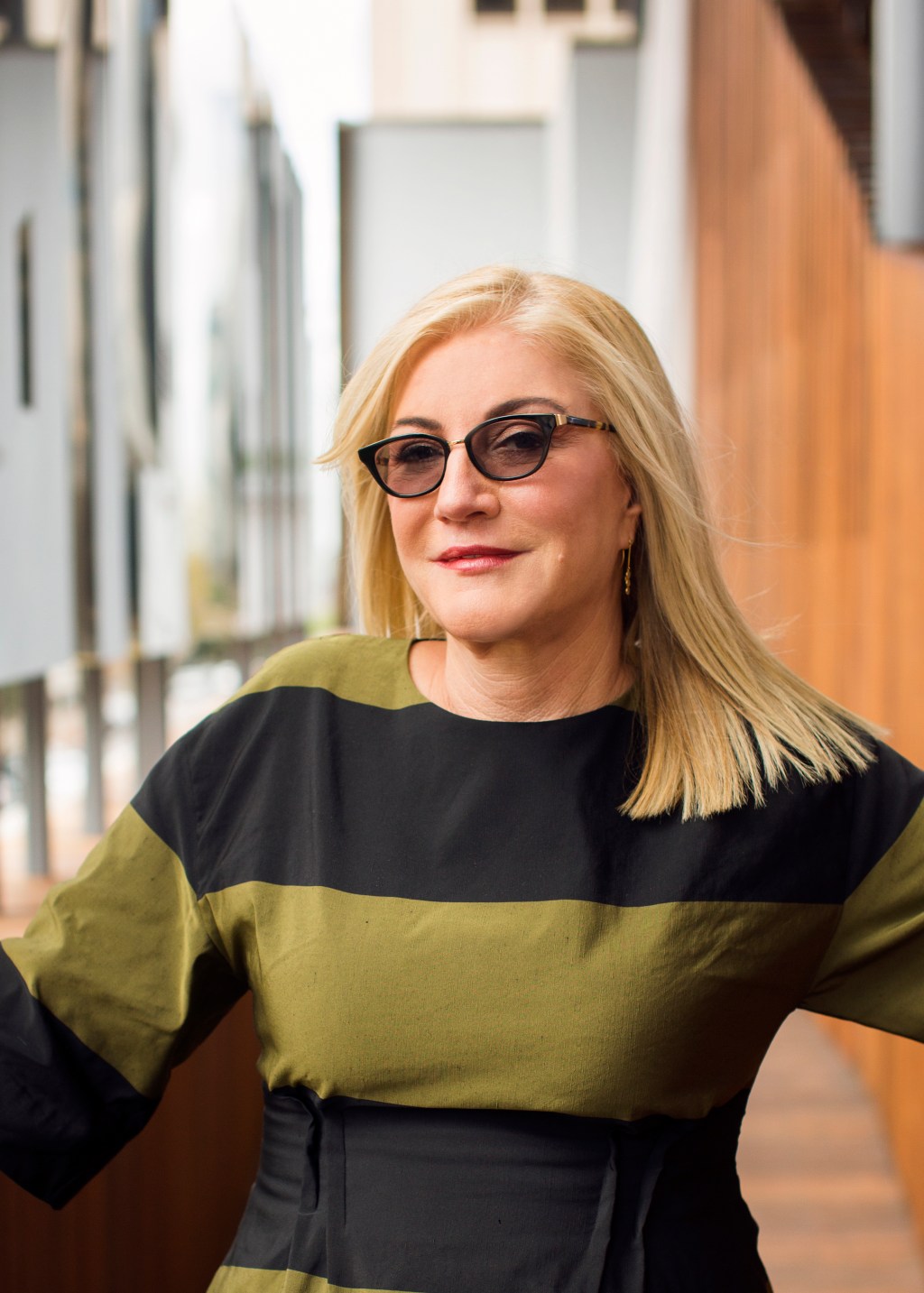
Suzanne Deal Booth stands among the most dynamic American Art curators, collectors and philanthropists. She is known for her expertise in art preservation and art history, nurtured through studies at Rice University and NYU and a former protège of mentor Dominique de Menil. Suzanne has worked for prestigious institutions such as the Metropolitan Museum of Art in New York City, the Centre Pompidou in Paris, and the Getty in Los Angeles.
Among her best known projects are: establishing Art collections for companies and universities, the patronage of James Turell’s Twilight Epiphany (located at the Suzanne Deal Booth Centennial Pavilion at Rice University), the creation of the Friends of Heritage Preservation (FOHP) and the Suzanne Deal Booth / FLAG Art Foundation Prize. She is also deeply dedicated to her vineyard in Napa Valley, Bella Oaks, which produces celebrated cabernet sauvignon grapes and olives grown with biodynamic and organic practices.
- Let’s begin with the Art collections you created for companies such as Dimensional Fund Advisors. Creating such corporate collections is a tricky thing: it has to embrace the company’s philosophy and you have to consider that this is a professional, public space. On the other hand, we have so many examples of curators working with companies that are so obsessed with being compliant and politically correct that they end up with a dull collection of decorative Art. How did you manage to create corporate collections that find the right balance?
{SDB} : I think it is very important to know your client. In this particular case it was an international asset management company that had offices all over the world. The collections were intended to be in offices where people are working 9-to-5 jobs, and the company was very clear that they did not want either sexual, politicized or violent work. That was a challenge and that’s what I liked about it: how to create a stimulating, interesting, thought-provoking collection without these types of works. It would have been much easier to create a collection of emerging artists that are all politicized, and these are easier to find. Instead I took the road to find non-figurative Art, and although it doesn’t have to be completely abstract, it can at times include some figuration but has to tell stories in a non-violent way.
In this collection there is a piece, which is one of my favorites, of an artist that takes photographs of empty zoos, framing the view from inside the cage out, making a statement about animals and captivity. This is what I call being thought provoking without being political, sexual or violent.
This company had offices in Sydney, Singapore, Tokyo, Hong Kong, Europe and the US. It was an opportunity to showcase a variety of artists from different countries and present how they think and express themselves. I also wanted the different offices to have something in common, so I decided to exhibit some of the same artists in different locations. Overall, I think this approach was very successful with that collection and the principals of the organization were very pleased.
For me the objective is to find the right connection. Just like for other collections I put together such as the one for Rice University or the University of Chicago. Particularly with the University of Chicago: the students come from all over the world and from very different situations (African American, Germans, Indian, Thai, Chinese…). So I went for a very different type of presentation for a very different collection.
- When it comes to your own collection, you seem attracted to any period or type of Art. Meaning that your collecting universe is almost endless. What makes an Artwork worthy of joining your collection ?
{SDB} : I have to like it ! I tend to live with my Art so I can experience it daily. I try to get them on my walls instead of my storage, so It has to be works I can live with, that I can walk by every day and feel good about it. It should have some qualities that resonate with me. I need works that become part of my ambiance. I have an Agnes Martin in my bedroom: it feels compatible with how I want to feel when I want to read, contemplate something or go to bed. On the other hand, in another bedroom there is a Lee Krasner from the Umbers series that is absolutely beautiful in low light, and is equally as commanding, yet calm.
I found when my kids were quite young, they very respectful and curious about the Art we had at home. Sometimes, I wonder: what if I had put violent or sexual, or over the top paintings on the walls ? Would my kids be different people ? Would they have a different orientation to the world ? I don’t know. Maybe we should ask people, who collect that type of Art.
You mentioned that I collect Art from different periods. This is true: some of the paintings I have are from the Renaissance or even objects from ancient Rome. Some have religious iconography, and even if they are small, they can totally illuminate the room. These works need their own environment, and really don’t do well around big, contemporary works.
- You tend to support Art projects as a patron. Does it mean that you are at a stage where you don’t even need to own an Artwork to enjoy it ? Is it somehow the ultimate form of relationship with an artist ?
{SDB} : Of course, yes. I appreciate a lot of artists I don’t collect. For me, being attracted to an artwork does not mean that I want to own it.
I am in New York at the moment. Today I am going to see a couple of exhibitions: Ruth Asawa Drawings at The Whitney this afternoon, tomorrow I want to see the Ed Ruscha show at MoMA… I make art part of my day, especially when traveling.
I don’t consider myself a curator, mostly an arts advisor and I take on projects because I find them interesting and I want to be helpful. If someone asks me to put together a collection or a body of work that resonates with them, we need to agree on the process to find the best works.
- Could you tell us about the Friends of Heritage Preservation (FOHP) project ?
{SDB} : The Friends of Heritage Preservation (FOHP) is an organization that addresses global preservation needs and this is precisely the area I am specialized in: I started my specialization in Art preservation at NYU Institute of Fine Arts where I also studied Art history. It was a dual master that included a four-year preservation program: two years in New York taking graduate classes and two years of internships in museums. Also, I was working at the MET while I was studying in New York.
My first professional position in conservation was at the Getty Conservation Institute, where I was setting up educational programs all over the world. I really enjoyed this position that helped me to understand how things work on a public policy level: sometimes when you want to have a positive impact, the best thing to do is to start from the top and instigate changes there. It was a good time to rethink my role in life: I wanted to move from the conservation lab and into the world at large to protect monuments. I founded the FOHP while I was serving on boards in Washington, advocating for Art preservation. I found that it is the best way to support this field, especially when it comes to endangered sites.
With FOHP, I found obvious partners in the ministries of culture or governments of different countries, and one of the leading international agencies in that area is the World Monuments Fund, headquartered in New York City. After running FOHP for 20 years and accomplishing over 80 preservation projects in 19 countries, and working with different organizations, we found the best way of moving forward was to join our forces with the World Monuments Fund. FOHP remains a separate group but now integrated into the WMF. We are specifically looking at their Watch List, which is announced every two years and brings attention to a select number cultural sites considered most endangered and in need of preservation. There’s never enough money to fund all the at-risk sites and monuments in the world, and by combining forces we are able to address even more of them and enfranchise a larger membership.
Last year’s project FOHP supported with WMF was in Lisbon, Portugal – the restoration of historic murals by José de Almada Negreiros at these maritime stations that used to be the first welcoming point of visitors to Portugal. The artist, both of Portugese and Sao Tomean descent, showcased the full story of Portugese people, including immigrants of African descent, whose contributions were critical to the prosperity of the country, yet often discounted by the regime. In fact, after Almada Negreiros completed these vibrant, evocative murals, the state was so displeased with the honest, subversive stories depicted that the murals were almost destroyed. I am glad they were preserved then, as I am glad that FOHP and WMF are working to not only preserve, but recenter them today through the restoration and reinvigoration of the buildings they adorn.
In addition to our more concrete efforts, FOHP also has a couple of projects that address intangible culture where language or traditions are endangered. One example is a workshop in Jordan where stone carving techniques are taught to Syrian refugees. It helps them to find a job outside the refugee camps but also allows them to take this knowledge and skill back to their country and maintain the art form. We had many students, many of whom were women, who never had any kind of training before. This is one project that has great potential but there are many others.
The Suzanne Deal Booth Art Prize, started in 2016 at The Contemporary Austin. It’s a biennial award chosen by a rotating advisory committee of respected curators and art historians, initially offering $100,000, a solo exhibition, publication, and public programs. In 2018, it became the Suzanne Deal Booth / FLAG Art Foundation Prize, offering $200,000, still covering exhibition expenses in Austin and New York, a scholarly publication, and public programming. The goal remains to recognize outstanding artists with a strong exhibition history, offering a transformative opportunity.
- Let’s talk about the Art Prize that you have created at the Austin Contemporary. How do you see it after four editions?
{SDB} : I think the Suzanne Deal Booth / FLAG Art Prize has been very successful. The intention was to provide a transformative experience for the Austin and now NY community. Austin is a community that does not have an international profile in the Art world, especially in Contemporary Art. The Blanton Museum of Art at the University of Texas has a great collection and does a lot of exhibitions, but this art prize brought a lot more attention to Austin on an international level. The prize is meant to be transformative for the artist and the community. Rodney McMillian, the first artist to receive the prize, is a full-time professor at UCLA, and since the prize, he has had more exposure and shows.
The FLAG Art Foundation joined the project for the second prize. Glenn Furhmann is a colleague and a friend. He wanted to create a prize for FLAG, and after researching, he approached me about combining efforts and offering a prize together. I thought it was a terrific idea because it provides another venue, another audience, and more money to the artist, which I think is important because so many artists don’t get the opportunity to produce a show to their full intention, which can be costly – creating new work, accessing new audiences, and producing a catalogue. So far, artists Rodney McMillian, Nicole Eisenman, Tarek Atoui and now Lubaina Himid: I think we are covering all the bases from music to performance, installation…even outdoor installations at the Laguna Gloria sculpture garden, as with Nicole Eisenman’s bronze sculptures.
So yes, I think it has been successful. We are still evaluating where it could have been better or where the weaknesses lie.
The Rothko Chapel located in Houston, Texas, is a unique and contemplative space that marries art and spirituality. This architectural gem, ordered by Dominique de Menil, was designed by renowned architect Philip Johnson and completed in 1971. It features 14 large-scale, abstract paintings by the artist Mark Rothko. In 2021 the Rothko Chapel reopened after a two year restoration program, an opportunity to celebrate its 50 years anniversary. Meanwhile the overall visitor’s experience is enhanced by the addition of the Suzanne Deal Booth Welcome House: it offers visitors the chance to delve into the rich history of the location. Serving as an enlightening introduction for those who are about to visit the Chapel.
- How did you come up with the Welcome House at the Rothko Chapel project ? What is the purpose of this building ?
{SDB} : I grew up in Houston, and consider it my hometown. I attended Rice University, where I worked with Dominique de Menil. Thanks to her, I became familiar with the Rothko Chapel and met the Dalai Lama while a student. I also played an active role as I helped with research on the Mark Rothko paintings in the chapel and participated in the restoration of the Broken Obelisk by Barnett Newman that has been vandalized. I feel very connected with the original intention that Dominique had with the chapel, which was to create a place for meditation across diverse beliefs. It was for all the denominations, and gave an opportunity to bring people that were interested in humanistic causes and civil rights together.
Also, this building is adjacent to the Menil Collection in Houston. The Welcome Center is where visitors can come, check in, and learn about what they are about to see. It’s the first thing visitors see when they arrive, and the Welcome Center prepares them to be grounded and ready for the quiet and mindful experience that the Rothko Chapel offers. I am glad to be part of this welcoming experience and the design of the building is beautiful, by the Architecture Research Office in New York.
- It leads us to Dominique de Menil who has been a mentor for you. What has she brought to you ? Do you feel that her influence remains in the way you approach things ?
{SDB} : Dominique was a huge influence on me. I lived with her for two years when I was in graduate school in New York. I stayed in a small studio apartment that opened on a Max Ernst garden. It was within walking distance of my school, and I felt very fortunate to be there, as she encouraged me with this largesse to be the best I could be. I also got the opportunity to spend time with her and to talk about Art. I refer to her as a humanist because Art was one thing she did but she was so involved in so many other aspects of life. The Rothko Chapel exhibits beautiful Rothko paintings but its true purpose was to bring people together who share a desire to investigate the sublime in Art and hear speakers from various religions.
I learned from her how to be and do more than one thing, because it makes a difference, if ones intentions are focused. At the time I was a student, and she did not know that sometime in my life I would have the opportunity to be a patron. I don’t think this is what she was trying to do, she was just being herself: connecting to those who had a shared vision of making the world a better place.
- If we talk about the Rothko Chapel we have to talk about Texas. Even though you have a very international career and you are able to connect with people around the world, you always keep a very strong connection with your local community. Is it something important to you ?
{SDB} : I have kept a special connection with all the places I have lived. I lived in Paris and I am still involved with the Centre Pompidou. I think I am a very loyal person. I have traveled to a lot of places but I still return to places I feel connected to. I was born in Texas, I lived in Paris, Rome, New York, Los Angeles. and I am involved with the Academy in Rome. I try to find places that resonate with me. As a curious soul, I want to be around creative people and to think about affirmative changes.
- You join the board of trustees of several prestigious Museums. What do you try to bring, as a Trustee ?
{SDB} : As a trustee to various organizations, I think I do bring an authenticity in terms of my training and my orientation. I have a similar background with a curator or an arts Director. I can talk the talk about Art and Museums from an insider point of view. Some are born into it, some people make their way. I am just happy to use all the things I have learned in life in a positive way.
- Among those museums, you have a specific relationship with the Centre Pompidou. You had an experience there, as an Art Restaurer. Now you are the President of the American Friends of the Centre Pompidou. Could you tell us a little bit about your relationship with the Museum as well as the role and the projects of the group ?
{SDB} : I had a close relationship with Dominique de Menil, the founder of the Amis du Centre Pompidou. When I came to Paris for the first time, I had a fellowship from the Kress Foundation to work in the restoration department at the Centre Pompidou. The Friends of the Centre Pompidou funded me to stay additional months, and I was the one and only recipient of the largesse of that group.
Years later, when they expanded the American Friends, I got involved as a patron. Steven Guttman, who had been chair of the group for many years and was ready to step down, approached me to take over the position, and I thought: I should do this, this is the right thing for me to do at this point in life… and now I will be able to spend more time in Paris, a city that I love.
In 2010, Suzanne took on a new challenge by acquiring the Bella Oaks vineyard in the heart of the Napa Valley with the same credo as any other cultural heritage she is involved with: to preserve its historical value and to write a new chapter.
- Let’s talk about your project at the Bella Oaks property. Why did you acquire it ? What do you want to do with it ?
{SDB} : I have always had a profound relationship with nature and Bella Oaks and the property are in the heart of Napa Valley, a location that is very special. There are other great places but this is the one I was gravitating to. I studied the history of wine when I was a student and my then husband, David, had worked in San Francisco, where he invested in several wine companies. We visited often, and one day, on a walk, we discovered this property. We decided : let’s do it ! It started very much like it was going to be a vineyard creating a great wine. Discovering the history of the property, I became entranced with creating an organic farm to produce the kind of clean products I would like to put in my body. We make olive oil, wine and other botanical products. We don’t produce them because I think it is going to make tons of money, I do it because I am motivated to make high quality products I believe in.
- You produce organic wine but also in biodynamic. Biodynamic is used around the world, including France, but not by everyone. So why choose this approach ?
{SDB} : Organic farming is really something I wanted to do because I think that what we put in our body is very important. Nowadays we don’t even know the effects of the stuff we put in our food. So if you have the opportunity to put something on your table, knowing where and how it has grown, I think you should do it. We are farming organically, and using biodynamic techniques. I produce a high-end wine I consider to be pretty wonderful. It may cost more, and may take more time to produce, but the end result is worth it and I have a great crew and a team that believes in our shared vision. It is a dream come true.
 Ink & Voices