
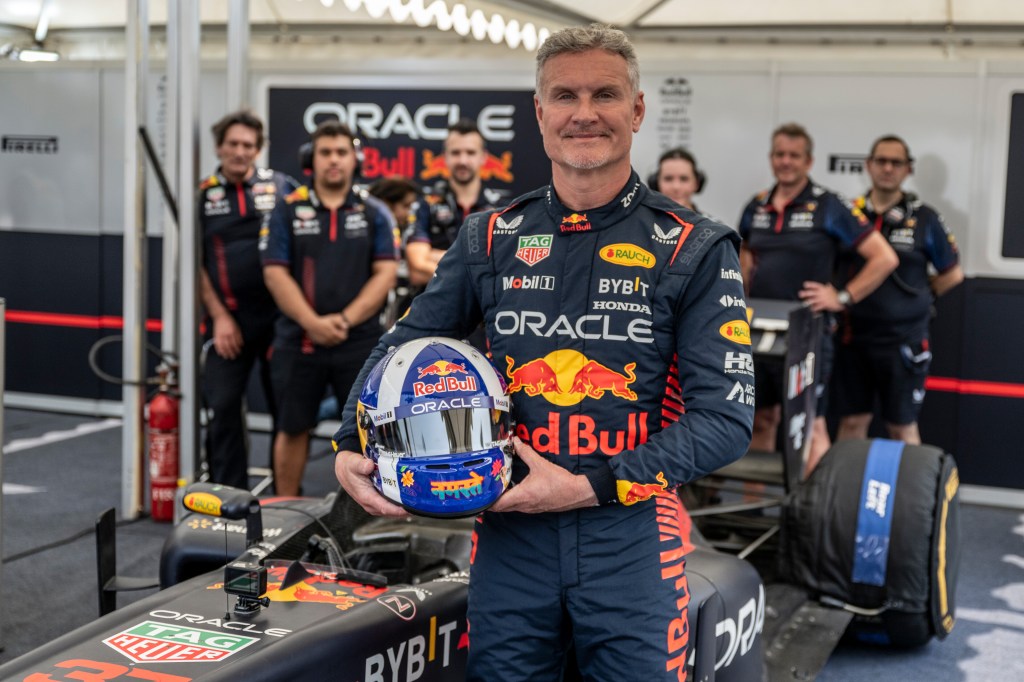
David Coulthard needs no introduction to anyone who has been somehow interested in Formula 1 over the last thirty years. For the few others, David Coulthard is a renowned Scottish driver who embarked on a successful Formula One career that spanned from 1994 to 2008. David competed for several top teams, including Williams, McLaren, and Red Bull Racing, achieving 13 Grand Prix victories and consistently showcasing his talent and skill behind the wheel.
After retiring from competitive racing, David Coulthard continued to make a significant impact on the sport. He took on the role of a special advisor to the Red Bull Racing team, offering valuable insights and expertise. In addition to his motorsport involvement, David Coulthard ventured into the world of business. He co-founded Whisper Films, a production company specializing in sports and television content, and Velocity Experience, a premium motorsport events and corporate entertainment company.
David Coulthard’s career has been marked by excellence in racing and a successful transition into various motorsport-related business ventures, solidifying his status as a respected and influential figure in the industry.
- You’ve been part of the creation of the undisputed leader of the F1 championship: Oracle Red Bull Racing. Let’s go back to the early years, when you joined the team in 2005. Back then, Red Bull was just a sponsor, an energy drink company that makes funny commercials. But surely not a car manufacturer. Did you imagine, when you joined them, that it would become the best team in the world ? Or was it only after several years, little by little, that came the ambition to reach the top..
{DC}: During the 2004 season I knew I was leaving McLaren and I was looking at what the options were, looking forward. Therefore, I had discussions with the management of Jaguar. This team was owned by Ford but was about to become the Red Bull Racing team.
I spoke with Martin Bundle, my manager at the time, an ex-driver who is a commentator now. I remember sitting with Martin and telling him that I just didn’t believe that the team had the foundation, or the ambition, or the structure to be successful and therefore I should not be driving for them, even though it meant stopping as a driver that year.
But I learned that Red Bull bought the company and I knew Christian Horner from karting days as well as when he was running his homeland team in 2000. So the conversation reopened regarding the fact that they might need a driver and I agreed to go and test the car. But I wouldn’t sign a contract before testing the car which was essentially the Jaguar car repainted from the 2004 season and I was maintained to do two days of testing. I said to the team: if I am good you can sign me, otherwise you can test other drivers. The driving of the car was what I expected: it was not the best carn, it was not the worst car. Based on my experience, faster cars are harder to drive, slower cars are easier to drive because by definition fast cars are more taking off the tires in terms of peak performance. I learned that, earlier in my career, driving with Williams and for McLaren: from the 1995 winning car to a not winning car.
So I met with their manager and I was struck by his quiet confidence and commitment to what the future would involve in terms of investment: to bring together the people to transform what was a mid grid team to a team that has a clear ambition to become a world champion. Because he had that ambition from the beginning. He understood that first: we needed to be credible and be respected; second: to build in the coming years the people. So I trusted in Christian and Helmut and I trusted the management in his very impressive commitment to the future. I was armed with that belief and that trust that I would be empowered to be honest with my feedback and my requests regarding the upgrades we needed in terms of people or hardware at the factory. I accepted the challenge and it paid off. In return for the investment, added to the time and the commitment of everybody, ultimately the winning foundation was built.
This is a great reminder that just like any business, the name above the door does not give you success. We have seen some of the biggest financial institutions collapse because of mismanagement or unfortunate management. See those big companies that were number one in the world such as Nokia and Motorola who slept because they did not move with the market. Just because you are called Apple or Ferrari does not guarantee anything. You have to keep on evolving and investing.
So, am I surprised that the team is successful ? No and yes. No, because why should you be surprised if you are working toward that goal? Yes, because how could I possibly know that they would be so successful?
- By taking you on as a driver, while you were in the latter part of your career, Red Bull seemed to understand that you could bring more than your talent on a racetrack. How important is the transmission of knowledge at Red Bull?
{DC}: I think that Red Bull is a mix of useful experiences. They invest a lot in young talented athletes. When you look at Max Verstappen and other young Red Bull drivers right now, you never know how long they will, or want to, perform at that level. So you have to constantly reinvest and try to find new phenomena. But sport teaches us: if you are good enough you are old enough; if you are good enough you are never too old. Fernando Alonso is a great example of that.
Some people are critical towards the Red Bull system, saying they bring drivers to Alpha Tauri and Toro Rosso and if they are not performing, suddenly they are dropped. But I see it like this: life is about seizing opportunities. A bit like Ricciardo at McLaren that was paid to leave the team a year earlier. Now Piastri is doing somehow more consistent performances than Lando and is doing better than Daniel was. This is confusing for us because Daniel is a Grand Prix winner and was exceptional at Red Bull and suddenly for some reasons it does not work so much at Renault and McLaren…
What I try to say, not trying to defend Red Bull, but it is that if some pilots were that good, they would have found a seat at Ferrari or Mercedes. They would have found a way. Just because you have an opportunity does not mean you’re gonna get success. You will have to deliver and not every driver has delivered. Just like for myself: when I realized that I was not delivering anymore and that the results were not coming, I stopped.
- You have a close relationship with the current drivers. Where do you feel they benefit the most from your experience? Is it about driving, career choices, communication?
{DC}: I would say that the benefit of youth is that you don’t know that you don’t know. I went through the growth from having no money, no opportunities in terms of life choices but with a desire to compete as a driver, up to suddenly being a driver, being paid well and having the financial opportunity to do certain things I could not do before. The risk is to become overly comfortable with your new financial opportunities and you become impatient because you get used to getting immediately what you want. But even for the richest person in the world, you can’t always get what you want. Let’s take health as an example… So, money has its limits. It’s an asset that allows you to do certain things in life but that should not control your life.
I mention that because you can’t give 100% to two things. When you arrive, you have nothing and you give 100% towards achieving a goal. When you get there, you have opportunities to have boats and planes and a lifestyle, you start diluting your effort. So what I think I can bring them is to understand that management teams will always try to create opportunities for them: personal sponsors, personal brands and T-shirts to generate revenues. But the problem is that it also creates work. So it is very important to understand what their job is and where their main revenues come from versus trying to build a brand for the future. Because if you are good enough on the track over a long enough period, your brand is built. But if you don’t, then it all falls down. So I would encourage them not to focus on the financial benefits off track, but to focus on your performances.
- You brought to Red Bull their first podium, in Monaco. You seem attached to this place. Why?
{DC}: I am a village boy who grew up in a village of 350 people in Scotland. Monaco has around 36 000 people. I have a place in Scotland because this is where my family is. I also have a place in London because I have businesses there. But I love Monaco, I love the security, I love the lifestyle. From my apartment I can see the Mediterranean. I can see the mountains behind me, where I can go skiing. I can go to Italy in 10 minutes. I can be in France in 10 minutes.
Also you have a very high level of security. Something that is important in today’s world, especially when you are in the public’s eye, even for an old driver like me, your security is so important. And even if you are not in the public eye you might have a nice car or a nice watch and you don’t want to live in fear for your security. I never lived in fear when I was growing up in Scotland. I would love to live there but it is not practical for the type of life that I live. Here I have a very nice, safe and secure lifestyle. So, somehow, here, I am happy.
- Perhaps the reason why F1 drivers have better business careers after retiring is that it takes more than just being a good driver to be a pilot. It requires being a good project manager, being good at finances and communication… It is not more difficult than being a football player but it is definitely more complex. What skills did you learn in your racing career that have been essential in your professional career?
{DC}: There are many great sports and athletes. But what makes Formula 1 different is the technology required to do our sport and the fact that, as a driver, you have to be part of developing that technology. So in that regard we are closer to a test pilot for aviation than someone who jumps high, runs fast or can kick in a ball very well. I am not trying to diminish the other sports because they also require a tremendous level of physical and mental commitment but what I would like to highlight is that in the racing industry, there are so many other levels. This is due to the fact that you are working with software engineers, hardware engineers, designers, cars and air dynamicists, with marketing and communication and also, of course, the financial aspect when you have to manage budgets and sponsorships. That is why I think it gives you a wide range of knowledge. Even if you are not an expert in any of those fields, it is important to speak a language that people from very different backgrounds can understand. You are participating in the development of the car, you are part of the solution. You are trying to solve a problem with the rest of the team and that creates a creative environment. Somehow, It’s like being a musician: you sit down and try a few notes on a guitar or a piano and a few hours later you might have a song that might touch people all around the world. This is the university of life and it’s helps you for the next phase
- You made your transition from pilot to media and then into the business world. Was it a natural transfer or did you feel like you were starting from the beginning ?
{DC}: It felt smooth because it felt planned. It was no surprise. Of course I did not know when I was a driver that I would end up being a shareholder in a production company. But I knew that I would work on television. I did not know that I would be a shareholder in an event company. It became clear to me that I went to so many events as a driver that there was an opportunity to do things in a more F1 way. I thought that I could have a competitive advantage here
- Your book: “The Winning Formula: Leadership, Strategy and Motivation The F1 Way” was published in 2018. Many people tried to find the “winning formula” as a pure theory. Others, the F1 drivers, had the opportunity to experience it. But you are a rare example of someone who both experienced it and theorized it. To do so, you asked other pilots to share their experience. What did you learn from them?
{DC}: Everybody is different of course. We all have different thought processes. So at the end all drivers have different approaches and you can learn from that if you try to understand and analyze. It’s about accepting that there is more than one way to achieve the same goal. And I think that often in life people are not challenged enough and fall into an arrogant space where they think that they make the best decisions. It might be the right decision for them, it does not mean this is the best or the most efficient solution. But most of the time they are just trying to go through what they have to do. So having better people around makes you want to be better. If you are surrounded by average, then you just need to be above average and, as far as I know, I only get one life to try to operate at the highest level. To have the opportunity to learn from people that are doing it is a privilege.
- You founded Whisper TV 9 years before “Drive to Survive”. By creating Whisper you showed a point: it is absolutely crucial for a sport or a company to share values and emotions with your audience. What makes Whisper TV special ?
{DC}: The founding vision was to operate as a Formula 1 team: to commit yourself and to complete the task as well as being self critical in what can be done better. Because so many times companies just deliver what they were supposed to, then move to the next mission without trying to improve.
Life is about making decisions and to understand that any decision might be the wrong decision. But as long as you took what you thought was the best decision based on the information you had at that time, you can’t be angry at yourself for taking what turned out to be a wrong decision. So I think it is essential to have the honesty to move forward and analyze what could have been done better and to implement it. That’s how racing teams operate and that is what we are trying to do at whisper.
It makes my partners nervous when during business presentations I say that we aspire to be the very best but we are not perfect because we are humans and we might make mistakes. But if we do, we can guarantee you it will be our priority to fix it, to minimize the fall out and to move forward. They don’t particularly like that I highlight anything that might be negative. But it is part of Formula 1 and any sport. It would be arrogant and narrow-minded to assume perfection. I rather like honesty and delivering what the customer asks for. Long term customer service is about being here when things go wrong. This is where your client needs you. Most of the time everything’s just fine. But this is when things go wrong that you realize how good they are. That is why I try to highlight that at Whisper: we are reactive to issues. Because at the end of the day they will occur.
- Could you tell us more about Velocity Experience ?
{DC}: We are focused on motorsports events and towards motorsports customers and again it is somehow like my family business, the transports: this is not a sexy business but it is essential to our everyday lives. I wish I could be sitting here explaining how I invented the Iphone or satellites where the returns could be somehow higher but I like projects where I can be part of a team. And also serve people: we provide experience for Formula1 teams for their partners and customers and we can do it with the knowledge of what is possible to do and by being sincere to the sport.
- And now your the co-owner of…a pub !
{DC}: By the way I also have an investment with Jenson Button and Daniel Riciardoand in a bier company in France, called Blue Coast. We start to see some traction, which is good to see.
The pub is not the closest from home, because I live in Chelsea. But I knew someone from F1 and through Jenson Button and I just fancied being part of a project where we can make a difference. We are doing the reopening next week. I want to continue to serve people and benefit the community. This is not an internationally known location but this is a nice pub that serves good food and drinks.
- Could you share a few words on your car collection?
{DC}: I have to admit that I am not a passionate car collector. Therefore, it is not a daily thought in my life. I have got all the cars that I raced from karting to where I am today. But it just happened more than being part of a master plan. It is true I have a couple of old Mercedes. But I am not a material person. I am a little surprised to have those things because they don’t have an effect on how I wake up in the morning or my mood when I go to sleep. They are nice things but what I like the most is life, people, and being part of a team.
 Ink & Voices