
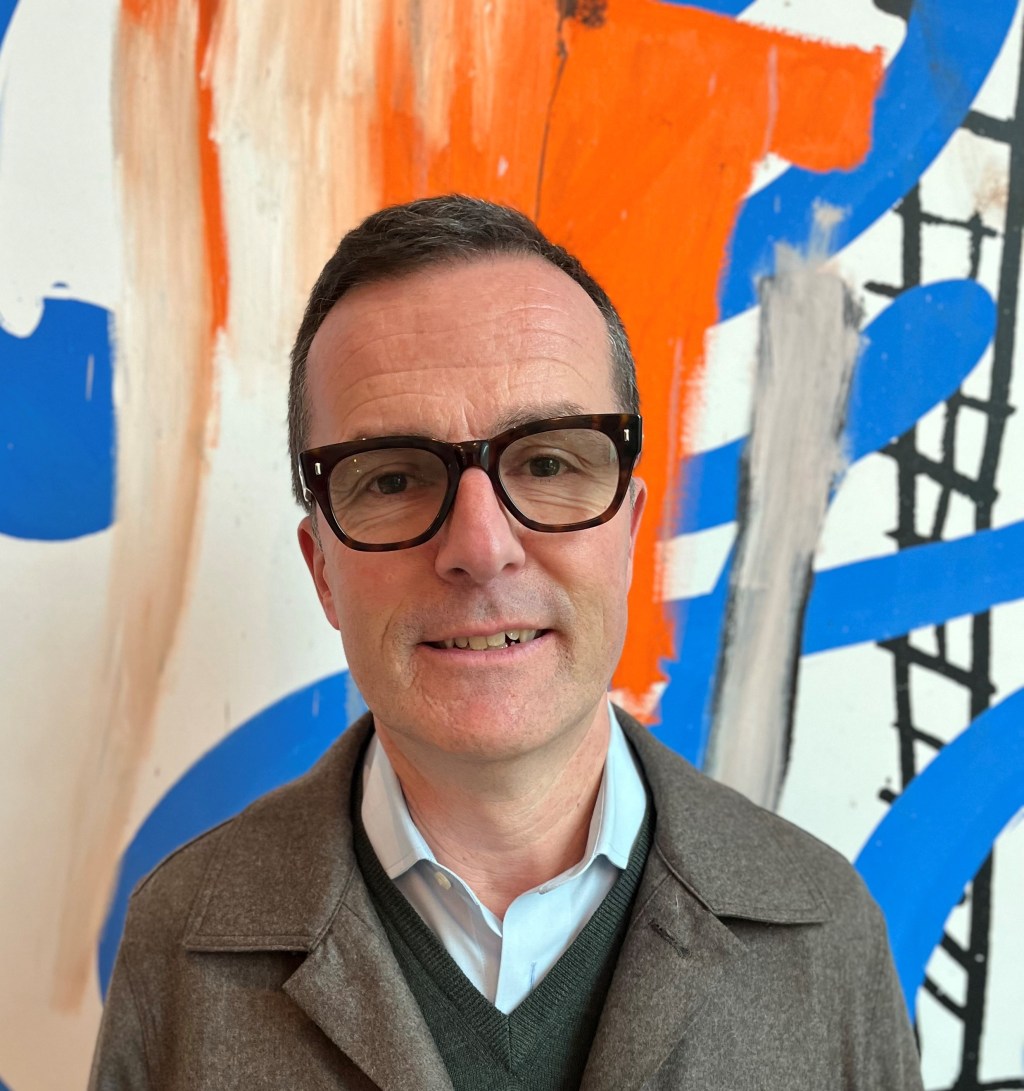
For over twenty-five years, Nicola Erni trusted her instinct and passion, gathering major works to create the world’s largest private collection of fashion photographs. This unique body of work shows the evolution of styles and trends since the 1930s, with a particular focus on the 60’s and the 70’s. The collection is also dedicated to contemporary art, including prominent works by Jean-Michel Basquiat, Julian Schnabel and Rashid Johnson. Part of the collection is on public display in two buildings located in Steinhausen, Switzerland.
The collection is managed by Stefan Puttaert, its CEO. Over the past 35 years, Stefan has held key positions at world’s leading auction houses, including Christie’s, Sotheby’s and Phillips. Today, Stefan is making the most of his extensive experience to support Nicola Erni’s project: sharing her collection with as many people as possible.
- Stefan, a first question about the evolution of the art market: you witnessed the crash of the market in the early 1990s, followed by 30 years of continuous growth. During these decades, many trends have followed one another: each season has its new emerging artist, its trendy gallery owner and its frenzied collector. What are your views on this period? How to generate sustainable market growth over the next 30 years?
[S.P.]: Indeed, I witnessed the market boom in the late ’80s, then the crash in 1990/91, which lasted for about 5 years. Since then, we’ve had a broadly positive trend, except maybe during the post-subprime crisis period. When I started my career, we had barely access to the Internet. Since the digital revolution, we have changed our working methods, like everyone else.
Regarding the current market situation, it’s true that we saw a bit of a wobble in the spring/early autumn season, particularly in London. But I’d like to point out that the New York sales didn’t go so badly, whereas some people were expecting the worst. I’ve also had some feedback from Art Basel Miami, and the situation doesn’t look too bad either. So it seems to me that the market and the buyers are still there, but perhaps more selectively.
I think that what has changed over the last 30 years is that the market no longer necessarily experiences such impressive market reversals as it used to, but instead goes through much shorter cycles. We’ve gone from longer cycles of 4/5 years, to shorter trends that only last a few months. Some emerging artists are thrown into the big auction game and break records, only to disappear shortly after. Although quite a few have focused on the NFT market in the past 2 years, this field has already lost some of its momentum.
- Despite this frenetic environment, Nicola Erni has consistently built her collection over more than 25 years, exploring in-depth certain artists’ works as well as some aspects of the history of photography. What do you think makes this collection so special?
[S.P.]: It’s a unique collection of photography (with a focus on fashion) and contemporary art, gathered over more than 25 years. Of course, other contemporary art collectors are interested in photography, but not at this level.
She was probably the first, if not one of the first in the late 90’s to collect photos shot by paparazzi. At the time, no one was interested in those photos but her. Nicola began to buy them one at the time; traveling around Europe to meet paparazzi willing to sell their pictures, quickly building up a small collection with a focus on the 60’s and 70’s. In a certain way, it was an introduction to contemporary art: during the Factory and Studio 54 period, Andy Warhol ruled over the New York art and social world, having Jean-Michel Basquiat by his side. When she started her collection, Nicola could not imagine that it would become a collection. And yet, as the years went by and acquisitions were made, it eventually did.
The collection of photographs were shown during the Zeitgeist & Glamour exhibition, for which we have produced a catalog. But Nicola Erni didn’t confine herself to photos taken by paparazzi from the 60’s and 70’s. She has also built this collection around fashion photography and portraits. It features some of the great signatures such as Irving Penn, Richard Avedon, Helmut Newton, Peter Lindbergh, Mario Testino… becoming the largest collection of fashion photography in private hands in the world.
Simultaneously, Nicola took her first steps into contemporary art, acquiring prints by Robert Rauschenberg. But her collection really started with Basquiat and Schnabel, focusing almost exclusively on those two artists for almost a decade. The two artists still represent two important parts of the collection.
The transition from Basquiat to Warhol felt natural, regarding the collaboration between the two artists. Eventually, she started to get interested in Warhol’s own work. This opened the door to a whole group of artists, including Keith Haring.
Another major part of the collection features hyperrealism works by artists such as Duane Hanson, Elmgreen & Dragset and Maurizio Cattelan.
Finally, a part of her collection brings together artists of the new generation, through whom she rediscovers certain aspects of the Warhol/Basquiat/Schnabel era, such as Rashid Johnson and more generally, everything that has to do with design, textiles and fashion, as seen in Sylvie Fleury’s work.
- Indeed, it’s a collection of contemporary art and photography, but it also involves fashion, design and architecture. Is this a way of recognizing these disciplines as forms of art in their own right? … that art doesn’t stop at the museum doors?
[S.P.]: Nicola had the first exhibition space built ten years ago, the second one opened in 2020. Many people thought that we would dedicate one space to photography and one to contemporary art. But that’s not Nicola’s intention: she wants to mix them and create a dialogue. A rather atypical approach for the contemporary art world that sometimes considers fashion photography as being from a second class category.
- Being the director of a private collection means establishing a dialogue with its founder, Nicola Erni. How do you manage to define, together, the curatorial program as well as acquisition projects, exhibitions and loans?
[S.P.]: We have a weekly meeting with Nicola and the collection management during which we discuss our next exhibitions in Steinhausen as well as loan requests from museums around the world. We study the several projects that have been submitted to us, as well as acquisition proposals. Nicola is very much at the forefront; she shares with us what she wants to accomplish. We’re here to give our feedback, based on our own experience. This dialogue leads to exhibitions in Steinhausen and elsewhere.
- So it’s a private collection, but that is shown to the public. To what extent does it influence your approach?
[S.P.]: The collection remained totally private until 2020. Until then, Nicola lived with her collection, at home. At some point she decided to create a space to enjoy it in good conditions. In 2013, she hired a building manager, then a collection manager in 2017. But for over 15 years, Nicola managed the collection by herself: from buying the works to dealing with the logistics… What she has accomplished is truly impressive.
The collection has its reputation, but is still a bit confidential for the general public. Our goal is to have it travel. Whether it means lending entire sections of the collection or few works to be included in a larger exhibition. This was the case with the Louis Vuitton Foundation and at the Philharmonie in Paris, or even at the Albertina in Vienna. The exhibition in Vienna just opened its doors and half of the works come from the Erni collection. Also, the Norton Museum of Art, Palm Beach, FL, has exhibited almost 300 fashion photos from the ’30s to the present day, all from the collection.
It was with the second space that Nicola realized she had to open it to the public and make it more widely known. We are now opened every Wednesdays and Thursdays.
Today, it’s our mission to make sure the collection gains international recognition and to promote everything Nicola has achieved so far.
- Private institutions tend to favor the white cube or Kunsthalle approach in order to get legitimacy. In your case, on the contrary, there’s a desire to present the collection in a more friendly and welcoming atmosphere. Do you think this might encourage people who are impressed by the imposing aspect of a museum to take interest in contemporary art?
[S.P.]: Our spaces are the total opposite of a white cube or a Kunsthalle. When you enter the buildings, you have this feeling of entering into a private residence, filled with design furniture, textiles and colored walls. In a way, this helps understand Nicola’s approach. We present a new exhibition every 1.5 to 2 years or so.
Another specificity is that taking photos is not permitted. The aim is to make sure the visitors enjoy the place and the works. We hope they’ll leave the collection amazed and with the intention to come back. Even more since we have two buildings to discover.
Just over a year ago, the MET trustees and Max Hollein paid us a visit. It was a very special moment for us. We were touched by the fact that they really appreciated this new concept of a House-Museum, which involves taking you into a place that could be a friend’s home. We’re most proud of the fact that Max Hollein (whose mother and wife are both fashion designers) was so convinced of our approach that he invited the architect with whom he works to visit us and eventually draw inspiration from certain aspects of our project. For us, this is a very nice sign of appreciation.
- Nothing is more ephemeral than a picture, all the more when it’s a fashion picture. What do you think makes a fashion photograph worth being preserved and exhibited?
[S.P.]: I think that above all, technique and support are crucial as they become increasingly rare. The physical medium offers the image a guarantee of longevity over time, as opposed to the digital image, which is permanently at the mercy of a simple click on the « delete » button.
Then there’s the photographer’s talent and the beauty of the work. This last notion is, of course, subjective: everyone can choose a photo that appeals to them more than the others.
The sometimes radical aspect of a photograph can also be important. This is particularly true with Helmut Newton and Mario Testino. We realize that some pictures published a few years ago could no longer be shown today. Even so, we sense that certain subjects are coming back, with a renewed interest for the 80’s as well as for supermodels.
- Social networks are an excellent way for you to showcase the diversity of the collection and highlight certain artists. Do you integrate digital communication into your curatorial project?
[S.P.]: Today, Nicola wishes to share with the public her collection that she loves so much. A wish reinsured by the positive feedback she receives. So yes, we’re very active on social networks to allow as many people as possible to discover the collection.
Since we’re at the beginning of the project to open the collection to the public, our aim is first and foremost to raise awareness and interest. Beyond the first visit, our ambition is for the collection to be perceived, through social networks, as a place in constant evolution. All too often, private institutions fall into oblivion for lack of renewal.
However, we’re careful to keep a certain amount of mystery around the collection and not reveal everything at once. This has to do with Nicola’s approach, who has been collecting for 25 years while remaining discreet. She tends to avoid the mundane events of the art world, preferring the company of friends.
Finally, I’d like to add that this digital communication is also a way of letting people know that other exhibitions can be seen all over the world.
- One last question: is there an artist you feel deserves more recognition than he or she gets today?
[S.P.]: I’d say that in terms of photography, one of the icons, Irvin Penn, is a little left on the side at the moment. Especially next to Richard Avedon, who’s all over the place as we celebrate his 100th anniversary.
Hiro is another great photographer who took incredible pictures during the 60’s and 70’s. He hasn’t benefited from the same visibility as some of his colleagues such as Newton, Avedon or Lindbergh, despite his wonderful career and his collaboration with numerous magazines. Yet he is well worth showing.
When it comes to contemporary art, I’d say more generally: hyperrealism. I remember that when we first acquired a work by Duane Hanson for the collection, he wasn’t that sought-after. But he is starting to come back into the limelight. Notably in Switzerland: on the occasion of the Beyeler Foundation’s 25th anniversary, Sam Keller gathered works from their collection with works by the American artist. The exhibition was a great success, and we loaned some of the pieces for the occasion.
Another artist Nicola brought into the collection early on: Nam June Paik. A way of showing an interest in art movements that worked with video and television.
 Ink & Voices