
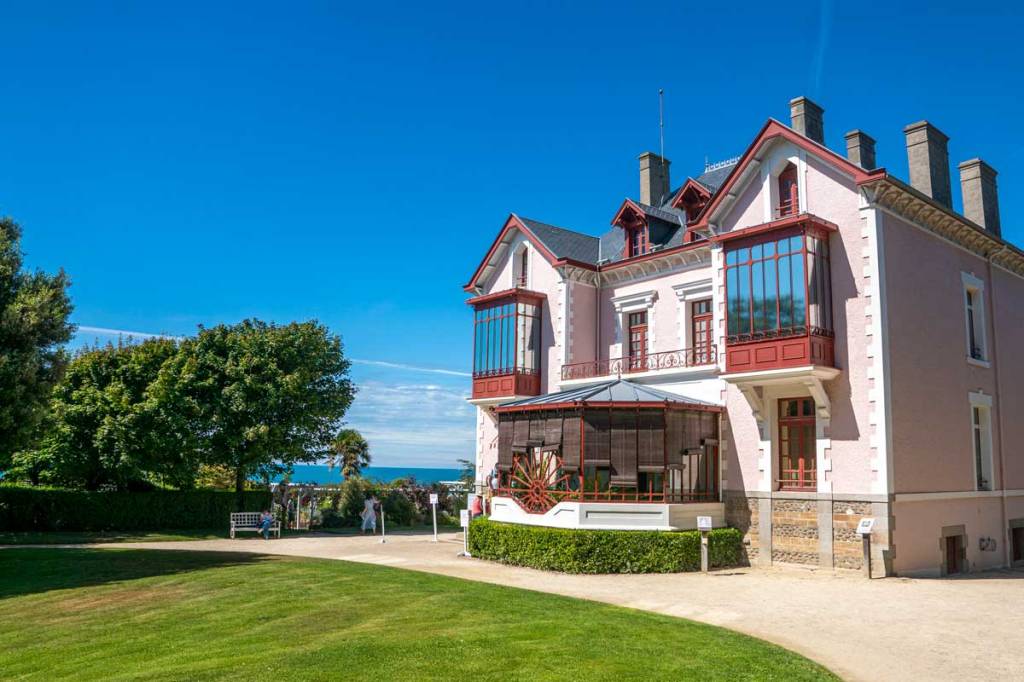
Christian Dior is without a doubt the greatest post-war fashion designer, and probably one of the most talented there is. Instigator of the New Look, his impact on fashion over the XXth and even the XXIst century is tremendous. The Normandy born fashion designer owes much of his creative universe to his childhood spent in Granville, in the Villa les Rhumbs. A place steeped in history and home of the Christian Dior Museum since 1997. The museum has been managed by Brigitte Richart since 2009.
- What does the Villa les Rhumbs mean to Christian Dior? How important was this place in his creative process?
{B.R.}: Somehow, we are all shaped by where we grew up, and this is all the more true when it’s an exceptional place like the Villa les Rhumbs, with its idyllic location and magnificent panorama. Christian Dior has spoken on several occasions about the major role of this property, and ultimately the region of Granville, in his life; both as a man and creator. A statement he later expanded upon in his writings.
The garden was of particular importance to him. As a keen horticulturist, he helped his mother, Madeleine, to shape it. Christian Dior thought that his passion for pink came from the flowers of the garden as well as the color of the walls from the villa. He also mentioned lilies of the valley among the flowers that reminded him of his childhood here.
Among other memories from his time in Granville, Mr. Dior evokes the cloudy sky as well as the carnival, which gave him a taste for costume.
- The Museum was founded under the determination of Jean-Luc Dufresne, who sadly passed away in 2010. You had the opportunity to meet him. What did you keep from your discussions?
{B.R.}: I not only had the opportunity to meet him, but also had the pleasure of working with him before he sadly left us in 2010. At the time, the museum was open from May to September. Together, we organized the first fall/winter exhibition, with the idea that we could make better use of our collection by bringing the place to life throughout the year. This project was in line with our will to raise the museum’s profile and increase its influence. However, we didn’t want to make it a permanent fixture, as our collection, made up mainly of textiles, needs a rest. We also wanted to continue to take the time needed to organize relevant, high-quality exhibitions.
Jean-Luc Dufresne was the visionary who made the Dior Museum as it is today. He understood very early on that the place, by virtue of its name and what it represents, would be able to take advantage of the craze for fashion history that was just beginning to appear. Time has proved him right: major fashion exhibitions have repeatedly made the agenda of Galliera, the Musée des Art Décoratifs and the Musée d’Arts de Nantes. Often with the support of luxury groups.
- The museum has an impressive collection of over 1,800 clothes, works and objects linked to Christian Dior. The collection is built up through donations and acquisitions. What are the highlights of this collection? What types of objects are you looking for?
{B.R.}: A distinction must be made between the original collection and its additions.
The original collection brings together a number of emblematic pieces, intimately linked to the history of Christian Dior. They bear witness to Christian Dior as a man, to his personality and to his journey. I’m thinking in particular about the famous star he stepped on in 1946, on rue du Faubourg-Saint-Honoré. The couturier being a deeply superstitious man, he saw in it a sign of destiny suggesting that he should found his own fashion house. The General Manager of Dior kept it his entire life, before the fetish object joined our collection. The original star can now be seen in the museum’s winter garden, while a facsimile is on display in the gallery, avenue Montaigne. Other personal items complete the collection: some of the watches that belonged to the couturier; and his last diary, which is empty beyond October 1957, for an obvious reason…
The collection was subsequently enriched by Jean-Luc Dufresnes through donations and acquisitions. We now go on by focusing on the 1947-1957 period, when Christian Dior was managing his own fashion house. We do, however, occasionally take an interest in more recent collections that make direct references to Mr. Dior’s legacy. Thanks to a donation from Dior, we recently acquired a number of Maria Grazia Chiuri pieces that almost literally reproduce the logo of the fertilizer factories owned by the Dior family.
For several years, I was in charge of a project as curator of Granville’s museums. Although I no longer occupy this position, it should see the light of day in the next few years. The idea is for the town to bring together its three collections in a single storage that meets the latest conservation standards. This does not mean, however, that the museum’s collection is in danger today: on the contrary, we have someone who works almost full-time to ensure that we preserve it in the best conditions. But regrouping our collections would make our job much easier.
- What is your relationship with the Dior company and more specifically with its gallery, which opened in Paris in 2022?
{B.R.}: The Dior museum is an association; administratively and legally independent of the Dior company and the LVMH group. Nevertheless, our relations are very close and on a nearly daily basis. We work in harmony and on good terms. This is not least because three-quarters of our loans are from Dior itself, which, through its “Dior Héritage” structure, has its own collection. Dior also helps us by promoting the museum through its extensive communications resources. More generally, I’d say that whenever the name Dior is mentioned in an advertising campaign, it’s an indirect way of promoting the museum that bears its name.
In return, we are sometimes asked to lend part of our collection to Dior, whether for the gallery or for other exhibition projects. The museum is currently lending the gallery a portrait of the couturier, by Nora Auric, to highlight the importance of women designers in Christian Dior’s universe.
- Was the Museum involved in the organization of the « Christian Dior, Couturier du Rêve » exhibition, which had a tremendous success at the Musée des Arts Décoratifs in 2017?
For many years, fashion historian Florence Müller has supported the Musée Dior in its curating process. So, when she was asked to organize this incredible exhibition at the Musée des Arts Décoratifs alongside Olivier Gabet, Florence was able to draw on all the work she had done in Granville. We served as a kind of laboratory. So the Dior Museum’s contribution was substantial.
We loaned a number of pieces for the occasion, including the amazing 1947 « diablesse » dress that opened the exhibition. Those pieces were then kept away from light to avoid overexposure.
- What is the mission of the « Présence de Christian Dior » association? To what extent does it contribute to the life of the Museum?
It operates in the same way as any other association, with a board of directors, an annual general meeting and office meetings. The association also organizes events and private visits, like any other museum association.
Occasionally, some members are asked to lend pieces from their personal collections, if they fit in with the theme of the current exhibition. This was the case for jewelry.
- You rethink the Museum’s exhibition every year. A way of keeping Christian Dior’s legacy alive. How do you define your curatorial approach?
It’s a question that comes up a lot. But we’re lucky enough not to be constrained by a restrictive framework. The theme of an exhibition may have come from Florence Müller or myself. Sometimes it emerges from a meeting, or from an opportunity that presents itself.
The 2021 « Dior en Rose » exhibition was suggested by Christian Dior Perfumes, who is on the museum’s board of directors. A subject that matched perfectly with the creation, at the same time, of huge six-hectare fields of roses at La Haye-Pesnel (not far from here), for the use of Dior’s cosmetics. The exhibition was therefore perfectly on point.
The « Chapeaux Dior » exhibition was our first to focus on a specific accessory. It was conceived around the work of Stephen Jones, and was the result of a proposal from the artist himself, after he had fallen in love with the Granville museum. We couldn’t refuse such a wonderful proposal, and we have absolutely no regrets about our choice. This highly original exhibition left a lasting impression. Beyond his attention to detail and professionalism, Stephen Jones is an extremely kind person. Which only made things easier. This exhibition was an opportunity to recall the importance of the hat for Christian Dior, and the fact that he lived in an era when ladies didn’t go out without headgear. He was therefore inspired by the traditional headdress from Granville: the bavolette.
In the end, that’s our guiding principle: to remind people that the relationship between Christian Dior and Granville is sincere and deep-rooted. There’s nothing artificial about it. So we feel it’s only natural to point this out whenever we can.
- Does the museum also have any off-site projects?
This can happen when we are approached by institutions. This was the case when an American museum used part of our Grace de Monaco exhibition.
However, we don’t take the initiative because we want to focus all our efforts on offering the best exhibitions possible to our visitors. Despite the space constraints that are a constant challenge for us.
- Since your arrival at the head of the museum, have you noticed a growing public awareness towards Christian Dior’s work and, ultimately, of the major role of fashion in our cultural heritage?
Is fashion an art ? I’ll ask the question without answering it. I would simply say that when I was studying at the Ecole du Louvre, there was no history of fashion. Now, it’s considered a discipline in its own right. This passion for fashion was only made possible by the determination of people like Florence Müller.
This recognition for fashion meets a public demand, and has the merit of rediscovering little-known designers. The Azzedine Alaïa exhibition at the Musée Galliera pays tribute to some of the couturiers who inspired him, but who didn’t achieve the success they deserved.
 Ink & Voices