
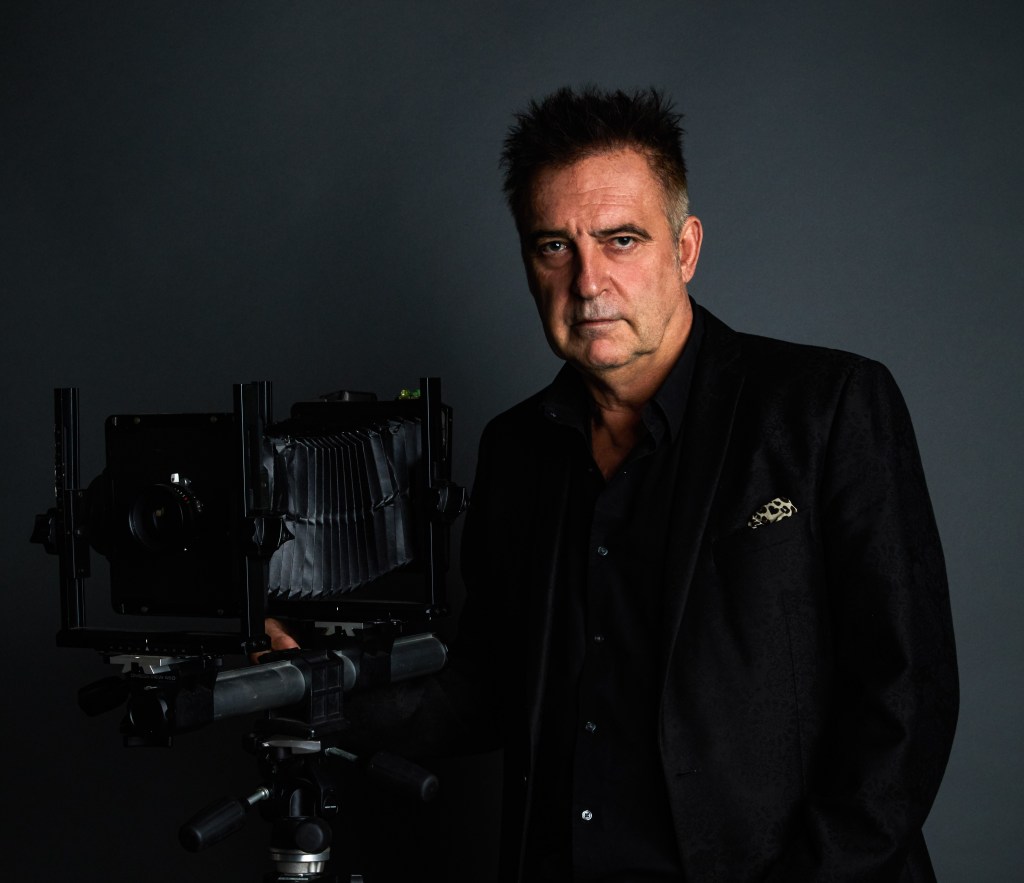
Since the end of the 80s, Antoine Verglas has been able to capture in an intimate style the beauty of the greatest models of their time. An approach that has won over the most prestigious brands and magazines. From Estelle Lefébure to Stephanie Seymour, from Elle Magazine to Vogue, from Victoria’s Secret to Louis Vuitton.
This journey is that of a Sup de Co student, model and television presenter who trained self-taught with big names from the photography industry. It is also that of someone who understood that luck comes about when we persist and seize opportunities; even if it means changing continents. No one is a prophet in his own land.
Antoine, you began your career in the mid-80s by multiplying audiovisual projects. A time during which you were able to seize the opportunities offered by a booming sector. To what extent did these years lay the foundations for your future career as a photographer?
{A.V.}: It was in 1986 when I just graduated from Sup de Co Rouen. It was a time when you had to know how to be reactive. I had already participated in quite a few advertising campaigns, as a model, when the opportunity to present a show on the French TV channel “5” came up. I prepared as best I could, I put all the chances on my side and I was finally selected by Françoise Rivière, the producer.
My spontaneity aroused the curiosity of certain personalities from the French TV industry such as Michel Drucker and Patrick Sabatier who wanted to know more about this young guy, living in his small Parisian apartment and who had suddenly made it, although it was known to be very a closed world. I also met Silvio Berlusconi who was the boss of the channel at the time. I took this experience as an opportunity to open up new horizons beyond modeling. What’s funny is that I met Nagui on the benches of a business school (HEC) prep school a few years before. He had a radio show on 95.2 and dreamed of breaking into the TV industry. Needless to say, he was a little jealous at the time, without realizing he would become one of the most famous TV hosts, a few years later.
It was an extremely enriching experience because I learned a lot about myself. Being in front of the camera is a real school of humility and at the same time gives you self-confidence. People are so critical about the way you express ourselves, the way you dress, the questions you ask, that you quickly accept that you can’t please everyone. I had built a shell for myself that allows me to accept criticism without getting offended. Ultimately, it was a much more educational experience than my academic career. This period lasted 8 months, until Berlusconi lost control of the channel. Subsequently, I was in contact with Antenne 2, another TV channel, to present the program “un DB de plus”, but it was ultimately Didier Barbelivien who took care of it. Somehow I knew I wasn’t going to do television my whole life.
Long story short, I continued to act in advertising films but I realized that the campaigns offered to me were less and less glamorous. I went from perfume ads and the Gini campaign in collaboration with Serge Gainsbourg to commercials for chocolate bars. So I made the decision to gradually end my career as a model and set up a photographer agency… Until I realized that I preferred to take the photos myself.
It must be said that I had already acquired some experience by working with numerous photographers that I had met during fashion shoots and I benefited from the excellent advice of a friend who was the assistant of great photographers. I started by taking photographs of my girlfriend at the time, a relatively well-known Swedish model. I also produced a series on the backstage of photo shoots.
Then one day my girlfriend went to New York to fulfill her contract as Face of the 80’s. It was a competition organized by the Ford agency; the equivalent of Look of the Year at Elite. I decided to follow her there. Just before my departure, I suggested to Photo magazine that we produce a story on top models through a series of photos and interviews, in the privacy of their apartment. The idea appealed to the editorial staff of the magazine who still wanted to see the result before getting involved.
Arriving in New York, it was Estelle Lefébure who opened the doors of the Elite agency to me. Meeting the director of the agency, Monique Pillard, gave me access to supermodels such as Cindy Crawford and Stephanie Seymour and generally to all the great Elite models of the late 80’s. Thanks to this help, I was able to produce around ten portraits in 3 or 4 months. I took a series of black and white photos with a somewhat candid approach, getting out of bed, in their bathroom or by the window, in lingerie or semi-nudity; as if they had been taken by a boyfriend. This without a team of hairstylists and makeup artists. This approach was the complete opposite of what was being done at the time. I accompanied them with interviews that I recorded on cassettes, asking them their zodiac sign, their favorite vacation spot, the restaurant or nightclub they liked to go to… In short, the type of questions/answers that we love reading during the holidays. This series allowed me to make myself known to major magazines and to begin my relationship with Victoria’s Secret.
So you are self-taught. How, at the start of your career as a photographer, did you manage to meet the expectations of an industry as demanding as fashion?
{A.V.}: Indeed, I trained self-taught while I was still a student at Sup de Co, notably with the great advertising photographer Oliviero Toscani, made famous by the general public through his campaigns for Benetton. I also had the opportunity to work alongside other photographers at the Pin-Up studio. I was able to learn on the job, by doing tests, the use of lighting, backgrounds and the rest of the necessary equipment. I was also lucky to have a very close friend, assistant to a famous photographer who helped me a lot when I was starting out.
When I had orders, I took on good assistants who had acquired solid experience with other photographers. I operated like a business manager, surrounding myself with the right makeup artist, the right hairdresser, the right stylist and one or two experienced assistants.
Your career took a real turn when you arrived in New York. A euphoric city, which gives you self-confidence, but in which you can also get lost. How did you approach the city and what impact did it have on you?
{A.V.}: New York is a city that gives you incredible energy, especially when you are very Parisian like me. In New York, there is this positive attitude that makes people spend their time using euphoric adjectives to tell you that you are going to make it. What I especially appreciated was arriving somewhere where no one knew me. Because in Paris in 1988, I had appeared in quite a few commercials and done TV. So I was, in some ways, bothered by being identified as the guy who was in the commercial for Balisto or Gini. In New York I felt free from my past and my parents. New York was still very new to me, it was an investment in the future. At the beginning, I alternated two-month periods between New York and Paris; because I had still kept my modeling activity in France in order to ensure an income. After a year I had saved quite a bit of money and was able to buy an apartment in New York.
I really moved there when the project of photos and interviews seemed sufficiently sustainable to me. I made an appointment with Jean Demachy who was the editorial director of Elle magazine at the time. I will always remember this moment: he welcomes me and I present him with a whole bunch of photos that I had printed with my assistant friend. He found the project interesting and offered to call me back within 48 hours after presenting it to the editorial staff. Finally, he called me back the same evening and invited me to come back and see him the next day at 9am. It was then that I met their director who immediately let me know that he was interested in the project which should include more color photos as well as a cover photo with Stephanie Seymour. I then immediately called Elite to suggest that Stephanie be on the cover of French Elle and Monique Pillar gave me the green light. A few months later, one of my photos was on the cover of Elle with 16 pages of interviews inside. For me it was a totally mind-blowing moment. This incredible opportunity was, in part, made possible thanks to Monique Pillard, who befriended me; maybe in part because I was French like her. I was a young photographer that she wanted to promote in order to thumb her nose at Marco Glaviano, a great photographer with whom she usually worked. It was a way of reminding him that he was not the only photographer on Earth.
My career continues and I realize that my work resonates better in the United States, that there is more enthusiasm there; while in France I still continued to carry around my past as a jack of all trades: both model, presenter and now photographer. This prevented me from being taken seriously and it created a form of jealousy: people wondered how I had been able to shoot these girls. I told myself it was better for me to stay in the USA and make my mark there.
My career really began between the ages of 26 and 28. Everything didn’t happen in five minutes but I managed to establish myself as a photographer before investing in different businesses: a bar, a nightclub and opening a huge photo studio with five sets.
You mentioned it: your success comes, in part, from the fact that you photographed certain models in their privacy. This gives a very authentic look to your work. There is an almost prophetic side to the emergence of social networks. Nowadays, public figures are in constant representation; even their private life is staged. Does the search for authenticity still have meaning today? and is it even still possible to find some?
{A.V.}: It is obvious that the smartphone and social networks have revolutionized photographic practice. Today, everyone is a photographer and celebrities are responsible for taking their own photos, showing off their new hairstyle and their new clothes. In the past it was the role of the paparazzi. The fact that everything is now instantaneous has made photography lose its mysterious, almost mystical aspect. In some ways, it’s a bit of a shame to have lost this element of surprise. In the past, we took Polaroids but we only had the results of the shoot at the end. Today the customer has instant access to photos. Sometimes, during the session, some people take photos with their cell phone and the result is almost better. But hey, you have to know when to evolve.
The other big trend is the decline in static photography in favor of video. In stores, posters have been replaced by screens that display animated images. This attracts much more customer attention than traditional photography. Of course, the classic photo still exists and we still need paper support; but in a different way. As with photography, anyone can make movies with their phone. This reduces costs and gives a younger, fresher, less sophisticated appearance. After that it remains a question of taste.
How did your transition go from film to digital in 2005?
{A.V.}: When a new technology emerges, I tend to take my time and adopt it gradually. I had gone from chrome to paper film and all of a sudden we went digital. I hired an assistant to make this transition. Once I got started, I realized that I no longer had to manage the entire development process: no more film or contact sheets. The advent of digital photography also launched a trend of extremely retouched photography. Nothing was authentic anymore and we had reached a point where the models looked like cyborgs. Today we are starting to come back and some photographers have even started using film again. To find a more natural look.
Let’s talk about it. Is the post-production and editing phase part of your artistic approach or do you rather leave someone else taking care of it?
{A.V.}: I really try to limit myself when it comes to editing. It’s a way for me to stay faithful to the style that made me known. I don’t try to digitally transform or use too many artifices like others who stage their subject. Using natural beauty is what I prefer.
Making videos: a choice of heart or a choice of reason?
{A.V.}: It’s an interesting medium. But the fact is that video requires a significant phase of pre-production and post-production; which takes quite a bit of time. During photoshoots I often take someone with me who dubs the photos into a video version, or who films the backstage, or even takes wide shots using a drone. It’s true that there is a real demand from customers in terms of video production. Today if you do commercial photography, it’s difficult not to do video. Clients generally request short formats of 15 seconds or 1 minute.
Apart from the big names in photography, do you have any other influences or sources of inspiration?
{A.V.}: In a way, we are always inspired by what we see. Thus, my photos can be inspired by a film or a photo that I have seen, even unconsciously. It’s almost inevitable. But I favor the inspiration of the moment so as not to get too locked into a fixed idea.
You probably didn’t think about it when you started your career as a photographer, but some of your photos are today considered works of art. Are you aware of this?
{A.V.}: It’s something that came completely spontaneously and is quite surprising because my photos were not originally intended as works of art. That said, it’s always flattering to hear that some of my photos have become iconic. But it’s not really for me to say, I’ll let others judge.
You travel around the world but Saint Barth seems to have a special importance for you. When did you discover this island and what do you find special about it?
{A.V.}: When you are a photographer you are constantly traveling. When I was based in Paris I went to the south of France, to Biarritz, to England or to Morocco. As soon as I arrived in New York it was Miami, Los Angeles, the Caribbean, Mexico, sometimes Hawaii… I even went as far as Tahiti. The advantage of Saint Barth is that it is a French island and I had the chance to go there very early in my career, for the Italian Elle, at the request of an editor-in-chief. In addition, there is no time difference with New York and it is only 4 or 5 hours by plane. Which is not very long, from the United States perspective.
I didn’t know this island at all and I discovered a very French place, unlike the other islands which can be very Americanized. In the 1990s it was still a little gem and you almost thought you were in Saint Tropez. So I fell in love with this place. Certainly, at the time, Miami was exploding on the fashion scene, but Saint Barth gave a much more exotic appearance. I went there with different clients, I met my wife and I had children there. Finally I lived there for two years with my first son. This island has become, in a way, my second home.
Do you have any other projects outside of fashion photography and if so, can you talk about them?
{A.V.}: I continue my activity as a photographer because I love what I do. Whether it’s fashion photography, portraits, swimsuit collections… But I would say that I also try to take photos with a more artistic dimension. With my wife we launched the CLIC concept store. Ultimately, I would also like to publish a new book of my work.
 Ink & Voices