
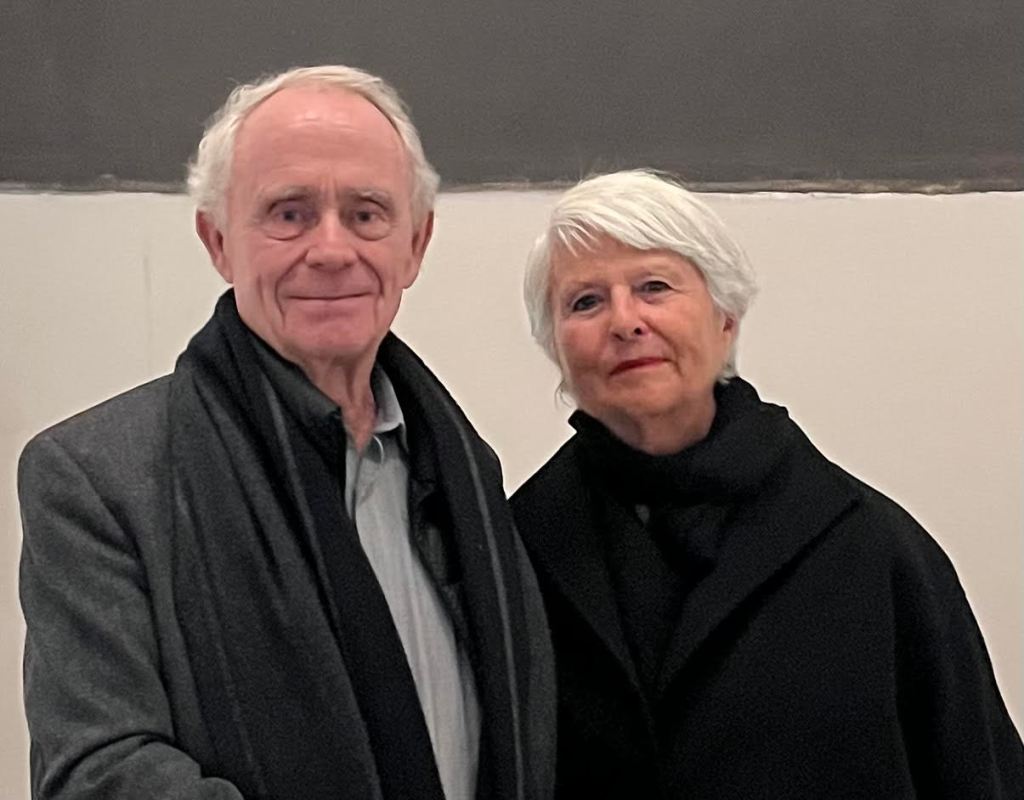
Since the mid-1970s, Françoise and Jean-Philippe Billarant have been passionately involved in the discovering and supporting artists with a focus on conceptual and minimalist art since the 80′. 50 years later, the couple has put together a collection including the biggest names such as Donald Judd, Lawrence Weiner, Dan Flavin, Niel Toroni, Carl Andre and Daniel Buren to name a few.
Their passion led them to open Le Silo in 2011, a 2,200 m² exhibition space, the result of the rehabilitation of an industrial building in Marines, in Val-d’Oise. The couple is also supporting contemporary composers, commissioning works from Philippe Manoury, Emmanuel Nunes, Marco Stroppa and many more.
Françoise and Jean-Philippe Billarant favor a direct approach and friendly relationships with the artists. Their approach, resolutely independent and free, far from speculative issues, reflects their deep attachment to contemporary art and creation.
- Did your professional activity and your passion for art come together? Or were they two completely separate activities?
{J-P.B.}: For us, these are two very distinct activities. I’ve never wanted to present works of art within the company, imposing on the other shareholders an approach which is entirely personal and which I share with my wife. Even if some of the shareholders are members of our family.
However, my professional activity has given me the opportunity to call on two architects whom I admire to design some of Aplix’s buildings: Harry Wolf in 1981 for our factory in North Carolina and Dominique Perrault in 1997 at Cellier-sur-Loire.
- You have put together an exceptional collection of conceptual and minimalist works. How have you been able to get into those movements, which are sometimes difficult to grasp?
{F&J-P.B.}: By doing our homeworks! We did our education by visiting museums and galleries, meeting art historians, critics, museum curators and, above all, artists. All these people enlightened us and some became our friends. They made us realize art is something that you learn. Classical painting requires you to master certain keys to understanding, such as perspective and the golden ratio. It’s the same thing with contemporary art! It’s not just a matter of taste, and it goes beyond the simple question of ‘I like it/don’t like it’.
We explored different artistic practices over 5 or 6 years. Of course, we made a few mistakes at first, but after a while we were able to say what appealed to us.
- Is meeting the artists important to you?
{F&J-P.B.}: This is probably the essence of our approach: to meet the most interesting artists of our time and understand how their work fits into the history of art. In fact, it is extremely rare for us to buy works without having met the artist. Maybe for some American artists who had just passed away.
When you discover Niele Toroni’s work, all you see at first are paint burshes on a white canvas. But when you realize that the artist follows an extremely rigorous protocol, systematically using the same No. 50 brush and spacing the forms 30cm apart in a staggered arrangement, then you are able to understand to what extent this search for the ‘zero degree of painting’ is part of the history of monochrome.
Of course, it goes both ways, and there have been times when we’ve liked a piece of work at first, but when we’ve met the artist we’ve been a bit disappointed by their approach. That’s part of the game.
- Did you feel a kind of incomprehension among some of your friends who had more traditional tastes when you threw yourself headlong into the world of contemporary art?
{F.B.}: Certainly. My husband went to ENA (Ecole Nationale de l’Administration), which is a very conservative school, so you can imagine what our friends thought of our collection. People tend to look at our collection differently now that this type of art is recognised and, even if it’s not the best aspect, its value has increased.
- Your collection is extremely coherent. Is this deliberate choice or simply the reflection of a very pronounced taste for certain artistic movements?
{F&J-P.B.}: All the artists we are following form a big family. They know each other and like each other. This line that we have chosen, this conceptual and geometric minimal art forms the coherence of our collection. We are sure of the luck that this art was not the most sought after in the years.
Lucky for us, this art was not the most sought after back then. It has to be said that certain artists who are now internationally recognised, such as Daniel Buren and Richard Serra, were much more accessible when we first became interested in their work 40 years ago. We didn’t know many people in Europe who were following them, apart from a few major Belgian collectors who became friends. We were lucky and in a way we were rewarded for our instinct and our choices.
- Your collection is exhibited in an old silo that you had renovated by the architect Xavier Prédine-Hug. Why did you like this place?
{F&J-P.B.}: Originally we wanted to find a place to exhibit works from our collection. Not out of vanity, but because we felt it was important to show the work of artists we love. Buying art is of course a financial issue for the artists, but nothing is more important to them than seeing their work exhibited.
For several years we looked left and right for a place that might suit us. It just so happened that at one point we had a window of opportunity that allowed us to sell some of our stocks in Alpix, while retaining control. At that point, we started seriously looking for a location. We live near the Parc Monceau in Paris and for obvious practical reasons we looked to the north-west of the capital. We were guided by the CAUE (Conseil d’architecture, d’urbanisme et d’environnement), which lists buildings of historical or architectural interest. We visited several sites, and finally the CAUE representative showed us this silo that had been left unoccupied since 2002. It immediately struck us as being in keeping with minimal and conceptual art. We bought it in 2007.
- Are you personally in charge of the silo’s management and curatorial agenda?
{F&J-P.B.}: Absolutely, we do everything ourselves. As far as the scenography is concerned, we start by using a scale model, and then we make scale representations of the works. This stage takes several weeks, even months. It has to be said that the works are be exhibited for two years. Then, for the installation, we call on five or six young people to come and work in the silo in our presence, and we tell them where to put the pieces. The final hanging is generally 99% what we had in mind. We rarely have to make last-minute adjustments.
We organize visits once or twice a week, which we do ourselves.
- Do you only show works from your own collection, or do you sometimes put on solo shows with works you don’t own?
{F&J-P.B.}: We present works from our collection, generally exhibiting several works by each artist. We try to ensure that the works resonate with each other. We take advantage of this to make a few winks, and when two artists like each other we take this into account in our scenography. Finally, we play with perspective, shapes, diagonals… in short, a number of elements found in modernism.
This is only our seventh exhibition since we opened the doors of the silo in 2011. Putting on solo shows would mean first and foremost finding artists capable of taking over the 2,200 square meter space, and the pace of our exhibitions would have to be much steadier.
- Do you think some artists in your collection deserve more attention?
{F&J-P.B.}: We make absolutely no distinction between artists, whether they have international recognition or not. We have a number of big names in American minimalist art, such as Donald Judd, Sol LeWitt, Lawrence Weiner and Dan Flavin. But we’re also interested in other artists such as Véronique Joumard, an artist and teacher at the Beaux-Arts de Cergy-Pontoise, whom we’ve been following for 40 years. There’s also Cécile Bart. These are two visual artists who deserve better visibility… although Véronique Joumard is now in the collection of the Centre Pompidou.
- Do you still discover young emerging artists?
{F&J-P.B.}: As you get older, you have to learn to be wary of yourself, because you tend to take an interest in artists who are really just followers of the artists you once liked. There are so many examples of great collectors or art dealers who, at the end of their careers, have gone completely astray by judging young contemporary artists by the yardstick of what had seduced them in the past.
Collectors are generally interested in the artists of their generation, the generation before them and the generation after them. After two generations, it becomes complicated. Quite simply because emerging artists have a different cultural background to us. Especially as we are seeing a return to figurative art.
But we’re not totally immune to what’s going on today. The last artist who won us over was 27 years old. He was introduced to us by Dove Allouche, his teacher at the Beaux-Arts de Paris, who noticed his talent. We found the work and the artist fascinating, and we bought one of his works. But this remains an exception…
It has to be said that since the 80′ we have another passion: contemporary music. It’s a kind of escape from an art market that has become too speculative for us. Here again, we can meet wonderful composers like Pierre Boulez. We commission works from composers, which gives us the joy of witnessing the birth of these works.
- You chaired the CNAP (Centre National d’Art Plastique) Board of Directors from 2016 to 2019. What was your experience like?
{F.B.}: It started with a last-minute change when the CNAP teams realized that I was too old to be allowed to chair the Board of Directors. I was therefore appointed honorary president and have attended two renewals of the board. During these 6 years I have known two directors, including the current one: Béatrice Salmon.
It was a fascinating experience, and I have a great deal of affection for this institution, which tends to take a back seat to the others, since its role is above all to lend works, not to present them with any will of revolutionizing the world of art. It’s a small team, but it does an exceptional job. The CNAP manages the State’s collection and holds thousands of works in reserve, as well as all those in institutions, embassies and museums. Not only in the field of painting, sculpture and installation, but also in the field of graphic design.
- Do you actively support institutions and museums?
{F&J-P.B.}: Yes, we’ve been involved with a number of institutions since the 1980s, in particular the FRAC Ile-de-France, the FRAC Pays de la Loire and the FRAC Bourgogne. We have also sat on the boards of the MAMVP and the Centre Pompidou. We had the opportunity to present our collection in various museums before opening the doors of the silo: whether it was Suzanne Pagé who invited us to the MAMVP as part of Passion Privées in 1995, or the Nouveau Musée de Villeurbanne and its 1500 m² that Jean-Louis Maubant made available to us in 1997, or Villeneuve d’Ascq and the FRAC Pays-de-la-Loire. Dominique Perrault has also asked us to lend some of our works for display in his agency, when it opened in 1997. We are currently lending a Carl Andre to the Centre Pompidou Metz for the Jacques Lacan exhibition. Other loans are planned for the coming months.
But we are becoming increasingly reluctant to do so because we have had some bad experiences. So now we only lend upon request from the artist or when we are sure that the loan conditions guarantee the integrity of the works.
- One final question: how do your children and grandchildren relate to your collection?
{F&J-P.B.}: our little-children experience all this very closely. They know the works in our collection and are careful with them: they know that you can climb onto a work by Carl Andre, but only in socks or slippers, and that you can’t touch the works, except those by Frédéric Joumard, which are heat-sensitive.
Each of our children have their own path and their own lives. The youngest has a body of work similar to ours, but he’s not as keen a collector as we are, in the sense that he only visits museums occasionally, and even less so galleries. They have a lot of respect for what we do, but we certainly don’t want them to do what we do.
 Ink & Voices