
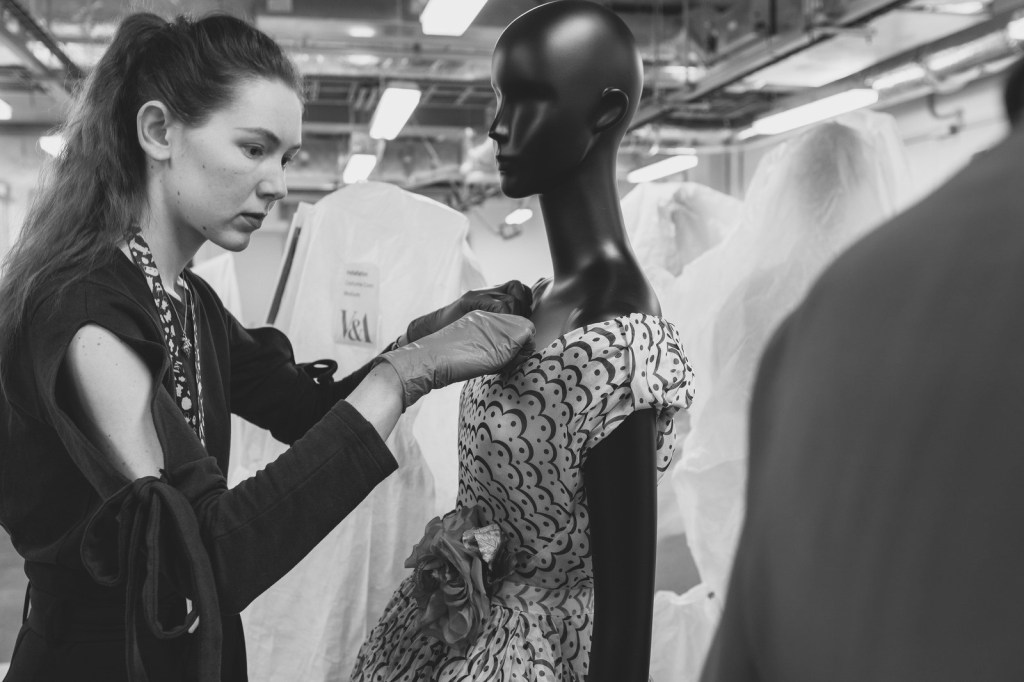
Connie Karol Burks is curator of ‘Textiles and Fashion Since 1900’ at the Victoria and Albert Museum in London. During her eight years at the V&A Museum Connie has co-curated two major sell-out exhibitions, Christian Dior: Designer of Dreams in 2019 and Gabrielle Chanel: Fashion Manifesto in 2023 and contributed to V&A exhibitions Fashioned from Nature, Africa Fashion and Plastics: Remaking Our World. Co-author of two bestselling exhibition catalogues, Connie studied at Central St Martins University of the Arts London and the Royal College of Art. Before entering the museum sector, Connie had a practical background in textile weaving as co-founder of the London Cloth Company.
- The V&A Museum is recognized as having one of the best fashion departments in the world alongside the MET and the Musée des Arts Décoratifs. What are the reasons for such a recognition?
{C.K.B.}: It is an honour to be considered within the realm of those two other great institutions. I suppose it originally comes from the fact that the V&A has a long history with fashion. The Textile collection began even before the founding of the Museum, with the formation of study collections for the Government Schools of Design in 1842. At the turn of the XXth century we became one of the first institutions to actively acquire fashion to constitute a strong collection grounded in history that has been updated through the past 100 years. It has a very broad spectrum, although there are always gaps that we are trying to fill.
One of the key moments that built the V&A reputation for fashion was Sir Cecil Beaton’s groundbreaking exhibition in 1971: Fashion, an anthology. It was one of the first times contemporary fashion was under the V&A spotlight. Before that, we were exhibiting mostly historical fashion. This exhibition in 1971, although there was historical fashion, was mainly focused on 20th century contemporary fashion. Presenting designs that were sometimes only a few years old in a museum, as artworks, was a turning point in photos and in fashion history, in the treatment of fashion in museums. The V&A has been one of the institutions that has been pushing the discipline forwards for the last 50 years, acknowledging and sharing the importance of fashion in our life to a wider society and culture.
- The V&A sets up partnerships with other major institutions. There is obviously the budget reason, but does it also have any positive impact on the quality of the exhibition ?
{C.K.B.}: Of course we do have to take the budget in consideration and doing partnerships with other institutions can really have an impact. But from my point of view, we have always been keen to do those partnerships because it is a way of sharing expertise and bringing together different aspects. It is a way to benefit from different research backgrounds and everyone’s strengths. It was particularly true in cases such as the Chanel exhibition: we worked hand in hand with the Palais Galliera so we could get access to each other’s collections and, as we know, they are only a very limited amount of surviving early Chanel’s garments. To be able to draw on the Palais Galliera’s collection and to show them here in London was absolutely fantastic.
- When you arrived at the V&A, you took part in the exhibition ‘Christian Dior: Designer of Dreams’. This exhibition has been a tremendous success. Could you share your experience ?
{C.K.B.}: It was a fantastic experience. The stakes were particularly high because we had a much shorter period to put the exhibition together than we usually do. But we were onboard to do things quickly. What really struck me when working on the show, and once we opened it, was the undeniable potential for exhibitions to prompt powerful emotions from the audience and to connect them with the story. We were very conscious that the exhibition was absolutely beautiful in Paris: you almost thought that time stopped; and when people were getting out, they sometimes did not really know if they were in it for ten minutes or two hours. Therefore we wanted to make sure that the magic would be felt in London as well.
It was also for me a great experience to learn about the importance of providing many ways of entrance into the subject. Because you get such a big and broad audience: from the fashion enthusiasts to others with no fashion background that were not interested in fashion but only came because they heard it was interesting to see. The purpose was to show those beautiful garments but also telling the story through different angles: the personal story of Christian Dior, his design journey, his biography, the individual stories of the wearers, the art of Haute Couture as well as the wider major cultural impact.
- During your studies at the Royal College, you became interested in tweed. This fabric has a fascinating history. How come it is still so successful and trendy in 2024?
{C.K.B.}: It’s a very good question and I am not sure of the answer but I will have a go, because as you said I thought about it a great deal. I came originally to tweed from a practical/makers’ point of view, in a company that produces tweed. I started to do studies on its history and thought it was a very strong case to highlight the shifting identities of textiles. Tweed shifted from being worn by peasants in the field with a sort of low status/utility background, to a fashionable status associated with the elite. Then it shifted again to be considered as a much more ubiquitous fabric worn by women and men for almost any occasion. It was interesting to study those shifts.
Working on Chanel was amazing for that because she did with tweed what she did with jersey. She took this practical, non luxury, fabric and turned it into something suitable for haute couture. Its quality, color and handle has changed over time. She was able to use such a wide range of tweed and even created a softer version. Everytime you think that we are done with tweed, a new young designer comes up and does something new with it. There is a fantastic Jamaican designer, Rachel Scott of Diotima, who does amazing things with tweed, she is drawing a very different narrative with this fabric.
- Did your knowledge of tweed and the different weaving techniques help you in curating the Chanel exhibition which was held at the V&A a few months ago?
{C.K.B.}: I am a strong believer that the foundations of fashion and the magic of garments come from textiles. So it was very helpful to have that practical understanding of textile. When it comes to looking at garments, it is extremely useful to draw on that making side. So I strive to get my head around those textile structures. It’s such a visual medium.
- This exhibition was an opportunity for you to publish a book presenting the objects and outfits that marked the career of Gabrielle Chanel. What was the impact of these creations on our way of conceiving fashion?
{C.K.B.}: There are so many publications about Gabrielle Chanel but one aspect that we felt that could be covered in a useful way was a deep dive in the garments themselves. That was the purpose of the book: to get a much more intimate relation with the garments. We worked with photographer Nicholas Alan Cope to do those beautiful photographs. For every garment we did at least one very zoomed in, closed up, picture that shows what is special about it: the way it is put together, the incredible stitchings, the embellishment or the embroidery. Because most of the time the beauty of Chanel’s works stands in the details. It provides that close look that you can’t get anywhere else. When I took people around the exhibition, I told them that you don’t notice the beauty of the garments when you are 10 feet away.
Also, we wanted to highlight the impact of Gabrielle Chanel on fashion; so we included a relatively compact, brief, biography, telling her story through her garments. We hope that it will inspire the designers of tomorrow.
- The V&A current exhibition is dedicated to divas, a flamboyant and fascinating subject. What is the origin of the project? What societal or cultural issues is the museum trying to address through this exhibition?
{C.K.B.}: All I can say here are second hand things because it is my colleague Kate Bailey that put together that show. She has a great track record for giving a wonderful, rich and hidden cultural context to things that are familiar to us. The Diva exhibition, for instance, look at the history of the term ‘diva’, exploring its origins, how its meaning has been subverted and embraced over time, and how the label has been reclaimed by performers, their fans and wider society.
- How do you define the curatorial program of the department?
{C.K.B.}: We are usually working 2 to 5 years in advance but those sorts of things always shift and move. So you are never quite sure when your exhibitions will really make it. What we are very conscious of is that, at the South Kensington site, we have several exhibition galleries. Meaning that we have several exhibitions happening at once. So there is always this consideration of what is a good pairing. For Christian Dior we had Mary Quant at the same time to present this fantastic Parisian Couture in dialogue with the London scene.
- You also shed light on lesser-known aspects of fashion history. Is this an important mission for the V&A ?
{C.K.B.}: We had obviously the Dior and Chanel exhibition and we have the Fragile Beauty exhibition coming up in partnership with the collection of Sir Elton John and David Furnish. Those are opportunities to bring private collections to our audiences. But it is really important for us to work on topics that speak to contemporary concerns and on historical subjects that deal with how history can help to understand the world today. For instance, Fashioned from Nature in 2018 looked back at the past to explore fashion’s relationship and its impact on the natural world to ask: what can we learn from the past to create a more sustainable future? Also, the great Africa Fashion exhibition that Christine Checinska and Elisabeth Murray pulled together is a really important moment and marks the beginning of a greater representation of African and African diaspora creativity within the museum. Since the exhibition has closed here in the South Kensington gallery, it has gone on a global tour. We pay attention to keep it alive.
- Your curatorial program is not limited to your exhibitions. The V&A produces a lot of video content shared on social media. Added to this are the training cycles, talks and meetings. Does it allow you to reach a different audience from the one who usually go to the museum?
{C.K.B.}: The physical space is the starting point in many ways but our activity is so much bigger. We have a wider program on site, within the museum, with talks and workshops. There is an increasing consciousness of creating online content, it is a really important aspect of our work. For the Chanel exhibition we did some object studies, which are very popular. It is a very nice way to have intimacy with objects but with a mass audience. One of the most popular types of digital content are the ASMR videos. We are engaging with people that were never thinking of coming to our museum. So it allows us to engage with people in a new way.
 Ink & Voices