
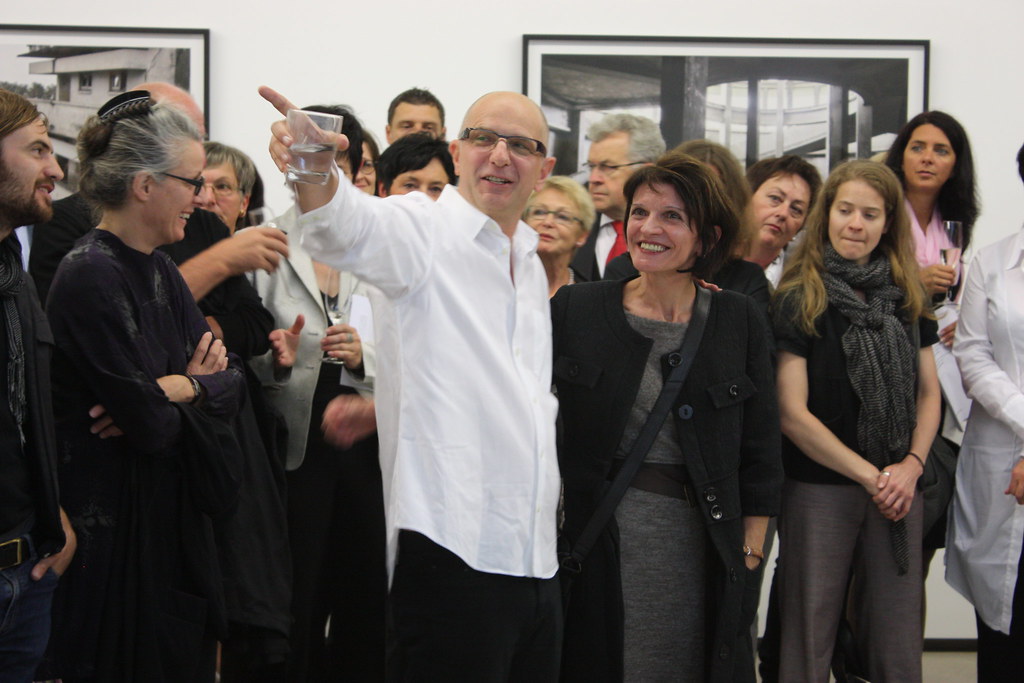
Former general partner at Goldman Sachs, Artur Walther transitioned into the art world in the 1990s, focusing on the acquisition and promotion of contemporary photography. Artur Walther is a prominent German-American art collector known for his significant contributions to the fields of photography and African art. His collection is particularly noted for its extensive representation of African and Asian artists, bringing global attention to often underrepresented voices. The Walther Collection has exhibitions in New York and Germany and is recognized for its thematic and cross-cultural exploration of identity, history, and memory through visual media.
- Artur, when and how did your passion for photography started ?
{A.W.}: My interest in art and design started in 1989 as I was in charge of opening a new office in Frankfurt for Goldman Sachs. This meant finding a working space, furniture and artworks to put on the wall. My specific interest in photography came later on when I left the bank as I was looking to experiment artistic practices. I quickly realized that painting and writing weren’t really made for me. It happened that I had a Leica as a birthday present and I started to be actively involved with the International Center of Photography (ICP) where I took more than fifteen courses. So this is how it started.
- Does it mean you wanted to become a photographer? Or was it just a way to have a first approach before starting your collection ?
{A.W.}: The point in taking courses was to open my eyes and to learn to see. Also, back then doing photography involved spending time in the darkroom developing and printing your own photos. This process allowed me to create and transform and to have a thought about what makes an interesting picture. Ultimately all the choices you make as a photographer say something about yourself. I did it passionately to a point where I could not sleep at night anymore, I was thinking about it constantly.
I took those courses for several years while at the same time I was joining the ICP and the Whitney exhibition committee. Those positions allowed me to get interested in other issues such as: what is an exhibition ? How to select the works ?
Also at the same time I was putting together an extensive book collection which is key for anyone being interested in photography. I learned a tremendous amount of things regarding photography through books: should it be its history, the different techniques and artistic approaches.
My collection started because I fell in love with the works of Bernd and Hilla Becher and their students. I met them several times and started to collect their works as well as getting interested in classic German objectivity. It was a very straightforward and clear process that served as my entry door to collecting.
- It seems important to you to meet the artists you are interested in. Why ?
{A.W.}: After being interested in classic German photography for several years, I was looking for something else. Being involved with institutions I did not see any point in exploring the same things as they did. Why would I want to put my mind into what has been already studied, exhibited and written about ? It was in the 90’ and I was traveling to China at a time when nobody was paying any interest to it. Christopher Phillips, a curator at the ICP, was interested in Chinese Photography and was also traveling there. So we kind of teamed up and put together an exhibition at ICP in 2004: Between Past and Future, New Photography and Video from China. It took me two years to understand the history and the culture of Chinese artists and make the transition from German photography. Then the Chinese economy boomed and everything changed. .
- Does it explain why you gradually transitioned towards African photography?
{A.W.}: Indeed, when China had that economic boom around 2005 everything changed and became so expensive. Suddenly I started to see artists living in mansions with maybe 50 or 60 people working for them. So I stepped back.
My interest in African art started in 1996 with Guggenheim’s exhibition: Africa, the Art of a Continent. As I told you I was looking at areas that were underrepresented back then. So later when I felt that it was time for me to focus more on African photography, I reached Okwui Enwezor, the great curator and scholar when it comes to African art and told him: “we are willing to fund a research trip to see what is going on the continent and maybe do an exhibition”. He was totally up for it. He and I traveled for four weeks and it resulted in the 2006 exhibition “Snap Judgments”. Having the opportunity to listen and learn from him was probably the best introduction to African photography I could get. I felt that my decisions were easier and a lot quicker. I was able to have deeper thoughts on whether or not the artist was showing me something I hadn’t seen somewhere else. I had the opportunity to develop my collection that, over the years, has fetched more than 2 000 images.
- When it comes to vernacular photography, the big question is: What is worth showing ?
{A.W.}: When it comes to vernacular photographs they can be scientific, medical and all sorts of origins but most of them are private photos you can find in family albums. Obviously there are millions around. Many are just random but others are sociologically relevant as they say something about individualities and the way people investigate or represent themselves.
- What prompted you to open your collection to the public and how do you define your curatorial line?
{A.W.}: The collection had grown significantly and the question was: should it stay in storage or should we do something with it ? My idea was to study that collection; to investigate and research. The quickest and most efficient way to do so was to create my own space, to get outstanding curators and publish books.
I had vernacular houses in Germany I inherited from my parents. So I decided to make them the home of my collection and to extend the properties with a modern underground space. This new space allows me to preserve the photographies in a safe environment
Also I have a studio in Chelsea, New York. I used it as my library and my dark room for quite a while. I transformed it into a project space when I realized Chelsea was becoming a hotspot for the art world. I curated small exhibitions that were somehow all connected so we brought them together in Ulm and published a book as well as curating a big exhibition on African portraits called “Appropriated Landscapes”. After that came other exhibitions including one focused on contemporary artists.
 Ink & Voices